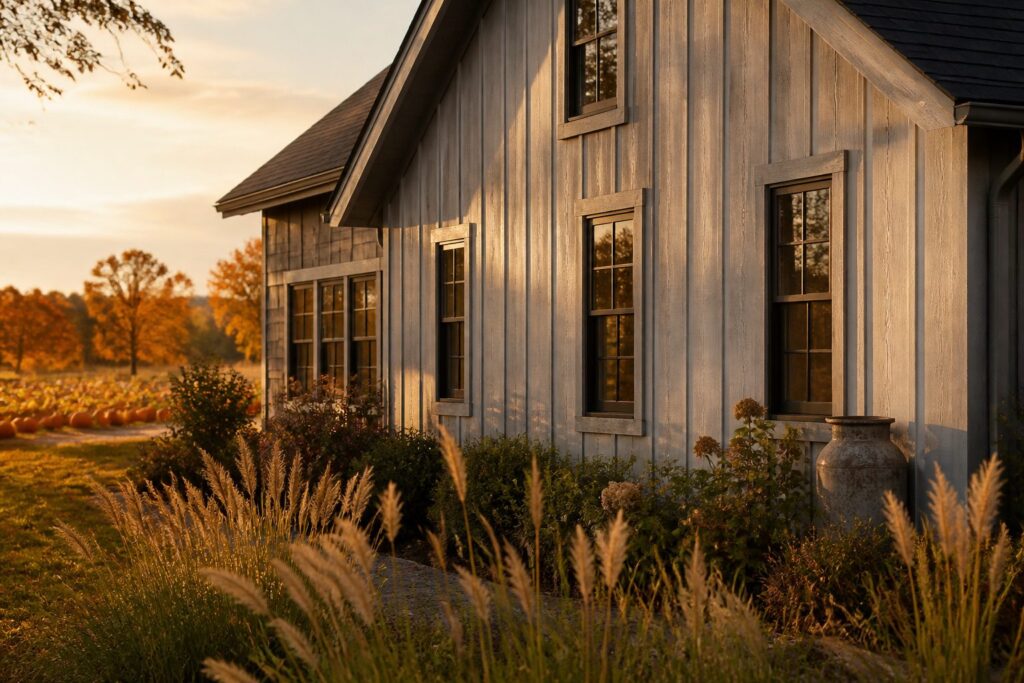
Board and batten exterior siding pairs wide vertical planks with narrow strips called battens that hide the seams between them.
The detail that ruins most first attempts is the gap between boards, and getting that right means the difference between siding that lasts decades and siding that buckles within a season or two.
Wood demands fresh paint every 5 to 7 years; fiber cement stretches that to 15-plus years; vinyl and metal need little beyond occasional washing.
[link-whisper-related-posts]What Board and Batten Siding Is
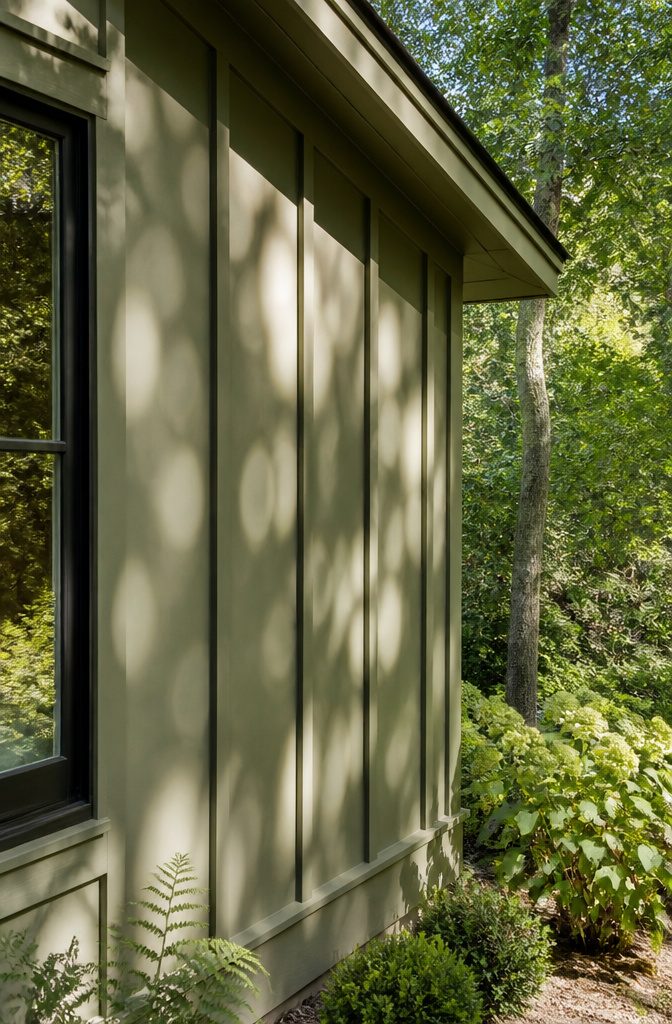
Board and batten exterior siding is alternating wide vertical planks and narrow strips called battens that cover the seams between them.
The boards go up first, flat against the wall, and the battens follow to hide the gaps while adding shadow lines that give the whole exterior depth.
This method started in Scandinavian barn construction and carried into early American farmhouses during the mid-19th century.
Builders back then could not mill wide boards perfectly enough to seal out weather on their own, so battens did the job cheaply and fast.
Farmers kept using it because the assembly was straightforward and the result kept heat inside better than log construction.
A typical board runs about 6 inches wide, while battens are commonly cut from 1×2 stock. That proportion, roughly six-to-one, is what creates the recognizable rhythm.
The style has survived over two hundred years for a reason.
Vertical lines draw the eye upward, which makes a house read as taller than horizontal siding does, and the shadow lines forgive minor wall imperfections that flat panels would expose.
What began as a practical fix for gaps is now specified by architects for modern farmhouses, cottages, and coastal builds alike.
Where battens once served a real sealing function, today they are mostly decorative, which gives plenty of room to adjust the spacing for whatever look suits the house.

Made of sturdy, smooth‑surfaced MDF, these wainscoting panels are lightweight, easy‑to‑clean and warp‑resistant. The burr‑free surface ensures a smooth, comfortable touch.
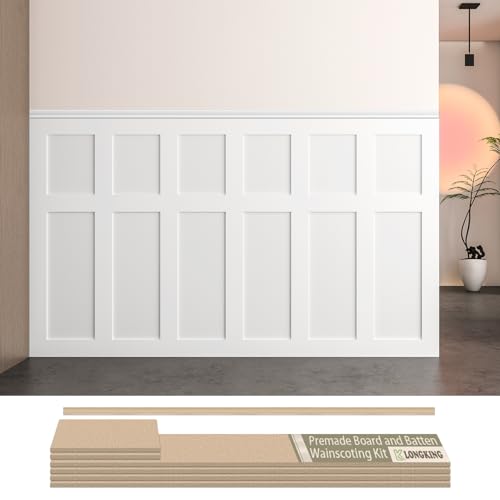
Board and Batten Wainscoting Kit – LONGKING pre-cut MDF wall panel kit is designed for easy DIY installation. Create a stylish accent wall with classic board and batten molding trim, perfect for modern and traditional home décor.

Preparing the Wall
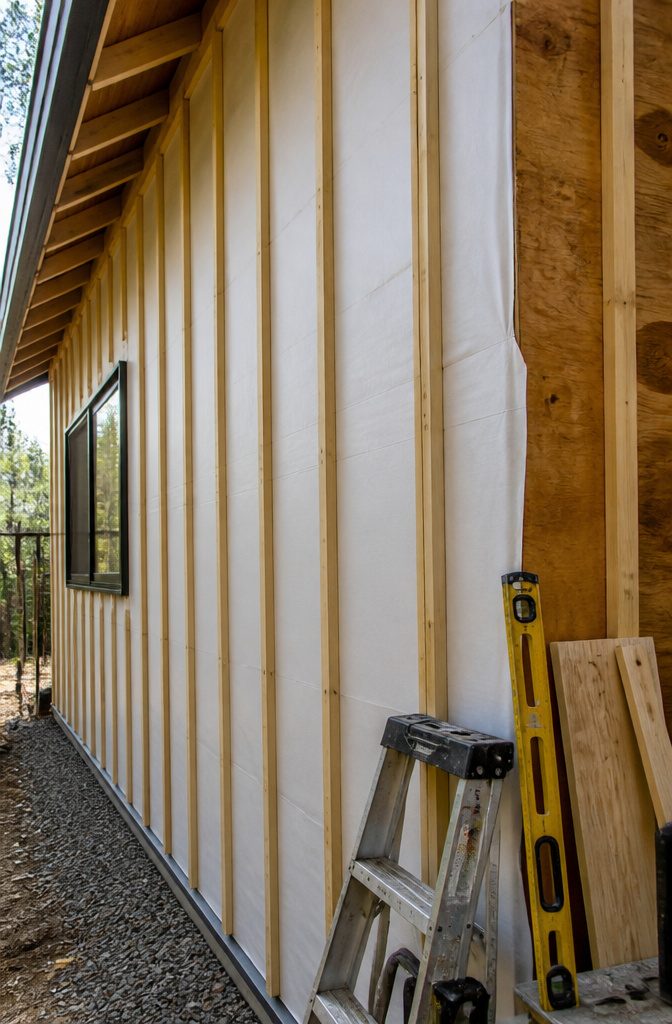
Old siding has to come off before anything else goes up.
I pry it away carefully, because the sheathing underneath tells the real story. Water stains, soft spots, or any hint of rot need addressing now, not after the new boards are hung.
A wall that looks sound from the street can hide damage where the ledger meets the brick, and board and batten will not forgive a lazy foundation.
Once the surface is clean and repaired, a weather-resistant barrier goes over the sheathing. Staple it taut, then seal every window and door opening with flashing tape.
Skipping this step is the single biggest cause of moisture intrusion problems in board and batten installations. In humid regions, I would add furring strips to create a rainscreen gap between the barrier and the boards.
That small space lets air move and water drain rather than trapping it against the wall. The barrier and gap together cost little extra time, yet they prevent the majority of failures I have seen in this siding style.

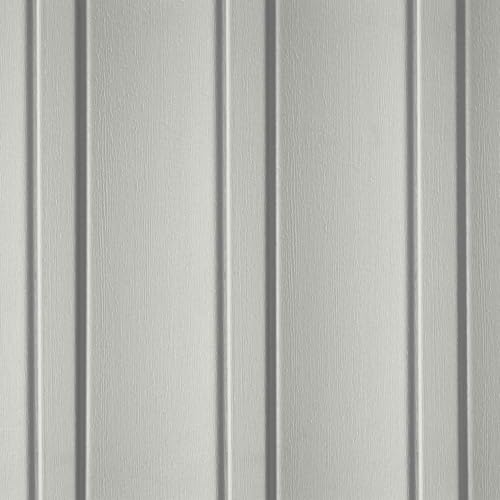
Most commonly used for whole house or accent applications

Handcrafted and manufactured in the USA
Installing the Wide Boards
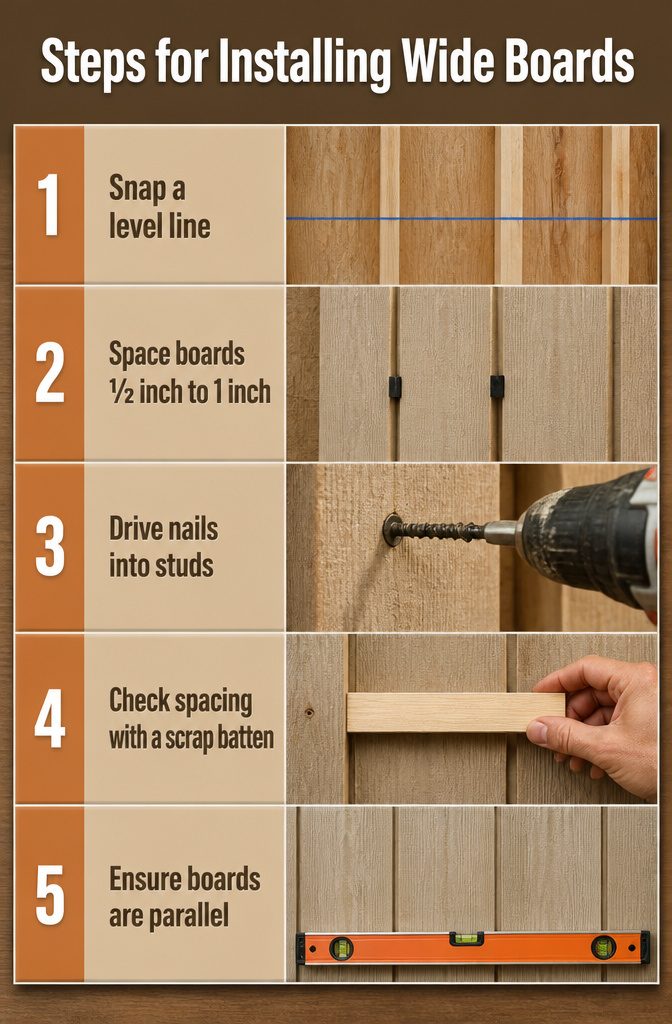
Spacing the wide boards at 1/2 inch to 1 inch is the detail that keeps board and batten exterior siding from buckling within a season or two.
That gap lets the boards move through wet springs and dry Augusts without binding, and it gives wind-driven rain a path out rather than a reservoir in.
I drive each board plumb, working off a snapped level line at the base rather than trusting the wall itself.
Corrosion-resistant nails or screws go into every stud, and I check spacing with a leftover scrap batten cut to width, not a tape measure I have to read each time.
The boards need to read as parallel from twenty feet away; a 1/4 inch drift over six feet looks like a mistake even if each board is true on its own.
Tight spacing, anything under 1/2 inch, traps expansion and forces the board to cup or split. Too loose, past an inch, and the battens look skimpy, sitting on a plank they barely cover.
The battens will hide the gaps later, but they do not fix a layout that was lazy at this stage. One board out of square now multiplies down the wall.

【Application】Xmnbl D0704DH fit for Diablo Hardie Blade 7-1/4 inch Fiber Cement Blade fits most 7-1/4-inch circular saws, tile saws and track saws. Compatible with Diablo, Dewalt, Skil, Craftsman, Makita, Metabo HPT, BOSCH, etc(The above brands are only used to illustrate compatibility). Such as for Skil 5080-01, Skil 5280-01, DWE575SB, DCS570B, CMES500, CS10, C7SB3, C1807DAQ4 saw. 7-1/4 " Circular Saw. Package includes 7-1/4-inch 4-tooth polycrystalline diamond-toothed circular saw blade with 5/8-inch arbor and a maximum speed of 8000 RPM

𝗢𝗻𝗲 𝗦𝗶𝘇𝗲 𝗙𝗶𝘁𝘀 𝗔𝗹𝗹 - This upgraded siding tool adapts to various siding thicknesses, including 5/16", 3/8", and 7/16"

Used Book in Good Condition
Attaching the Battens
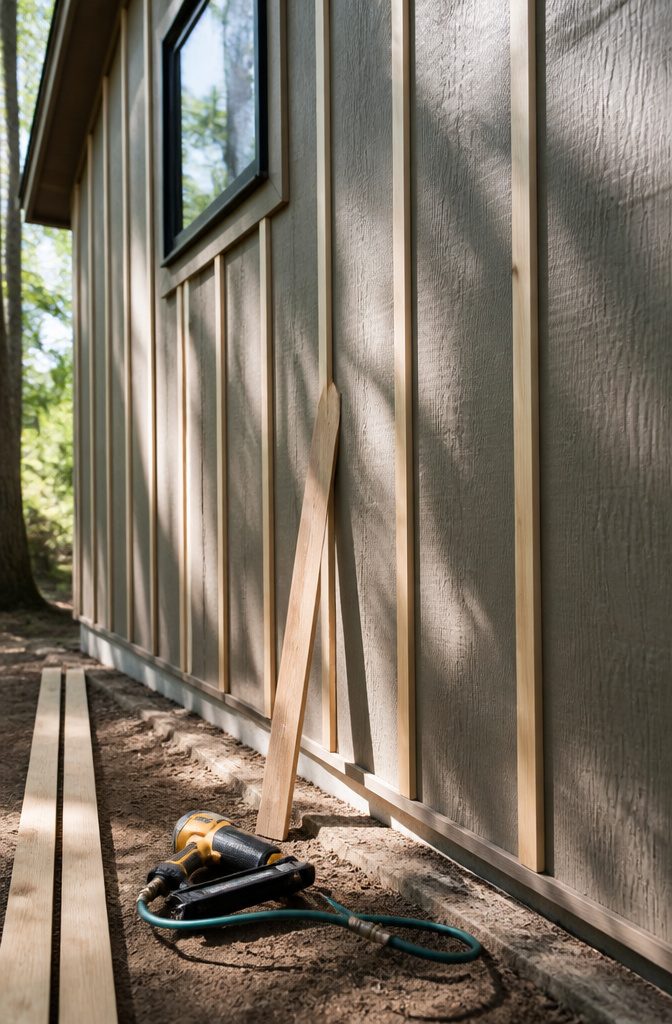
Battens sit centered over the seams between wide boards, not between them.
That placement hides the gap and gives board and batten exterior siding its shadow-line texture. Spacing between boards usually runs 1/2 inch to 1 inch, enough for seasonal movement without leaving a strip of wall visible underneath.
Fasten each batten through its center with corrosion-resistant nails or screws driven into the studs below. That single line of fasteners lets the wide boards expand and contract across their width as temperature shifts.
Nailing both edges of the batten locks the boards in place, and the cumulative stress eventually buckles the wall. I would skip screws altogether on wood over wood; ringshank nails grip without the thread shear that splits old studs.
On fiber cement or engineered substrates, screws make more sense, but the pattern stays the same: one line down the middle, spaced to keep the batten flat without strapping it rigid.
The battens themselves are narrow, typically 2 to 3 inches wide, so there is little margin for a wandering fastener.
I mark stud locations on the boards before the battens go up, then transfer those lines to the batten face with a light pencil tick. It slows the work by minutes and saves hours of fixing a waved wall later.

Complete, Quality Skirting Solution: our mobile home skirting panels are tailored to meet your needs, offering 8 panels, each measuring about 35 inches tall, 12 inches wide and 0.047 inch thick; This generous quantity ensures you have substantial coverage for your mobile home, ensuring minimal waste or excess; These panels offer durability, resisting damage from impact due to their thick, non breakable design

Effortless Application for Seamless Repairs: with our vinyl siding repair kit, effortlessly trim the vinyl siding patch to your perfect size using just scissors, no extra tools needed; Simply clean, peel, stick, and paint to match your surroundings; This vinyl siding repair tape ensures a flawless blend, whether you're using it as a vinyl fence repair kit or a mobile home skirting kit
Size : 6.3 Inches x 4.75 inches
Sealing and Finishing
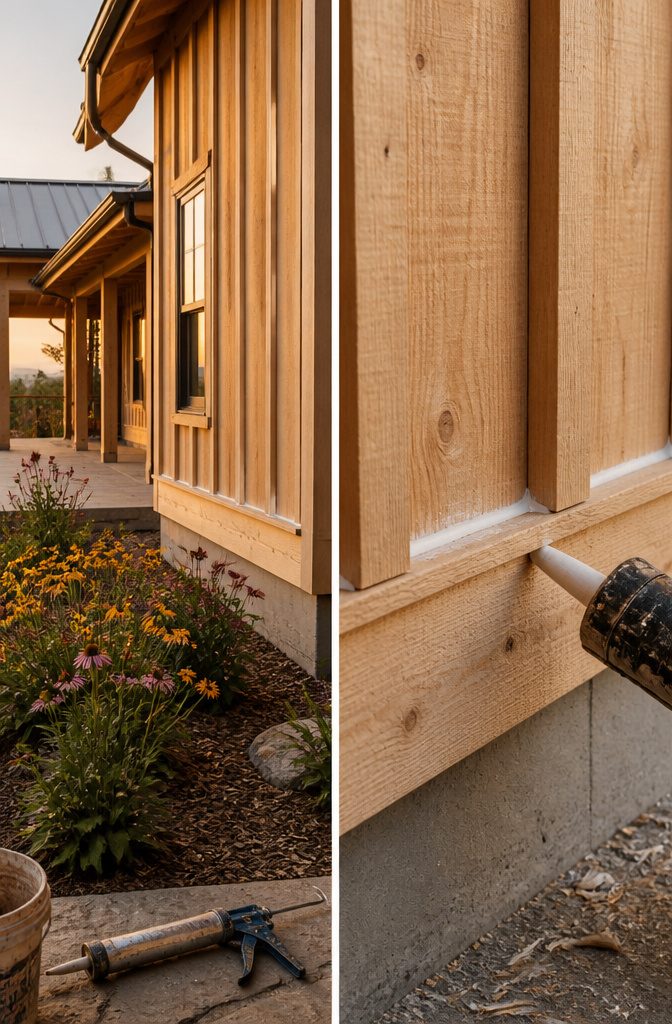
Caulk closes the seams your eye already found.
The battens hide vertical board edges, but horizontal joints at trim, skirt boards, and the narrow gaps where battens meet board faces all stay open until you run a paintable exterior sealant into them.
Fiber cement and vinyl siding resist moisture well enough that some installers leave micro-gaps at horizontal laps to let the wall breathe; wood demands every seam filled, because untreated end grain swells and the repair costs more than the tube of caulk you skipped.
On raw wood, the finish layer matters equally.
Cedar resists rot on its own, yet decades of service still need a high-grade paint, stain, or sealant reapplied on a schedule you set by sun exposure, not by whether it still looks okay.
I would stain over paint if the grain is worth showing, paint over stain if the boards are common pine and the budget is tighter.
Both need dry wood and a weekend of weather in the forecast; rushing either guarantees peeling before the next project season opens.
Leave no seam unsealed on wood is the rule that separates siding that lasts from siding that lists.

Reliable Rough Opening Sealing: ZIP System Flashing Tape for windows, doors, and rough openings supports seam sealing to help block moisture intrusion; 3" width is best for seam sealing

Contains no VOC’s and won't off-gas

CREATE WEATHERPROOF SEALS: Flashing tape provides waterproof seal with all-weather performance; long-term performance in temperatures ranging from -40 F (-40 C) to 240 F (115 C); 6-month UV resistance
Wood Board and Batten
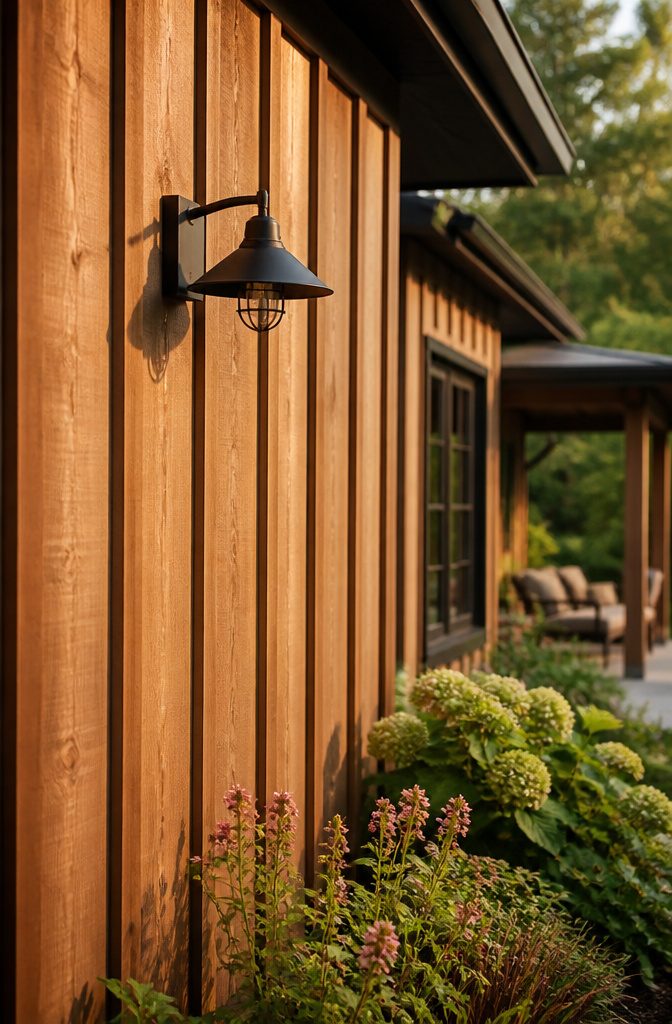
Wood board and batten carries a warmth no factory finish has fully matched.
Cedar and redwood show grain patterns up close that fiber cement only approximates, and in the right climate that character lasts: four decades with proper care is realistic, not marketing talk.
"Proper care" means repainting or restaining every 5 to 7 years, plus twice-yearly inspections for cracked boards, rot pockets, and insect damage.
Termites and moisture are the real threats; wood invites both. Humid climates and coastal salt air accelerate the timeline, so the maintenance burden rises sharply there.
Wood wins when the authentic texture matters more than your weekends, and when your climate cooperates enough that prevention stays manageable.
I would skip it for a full exterior in the Southeast or within a few miles of salt water; the vigilance required stops being a project and becomes a part-time job.
For a limited accent wall in a mild, dry zone, though, the material still justifies itself.

[PEEL AND STICK BASEBOARD] 0.1 Inch (thickness) x 4 Inch (high) x 20 Ft (length). Self-adhesive backing, easy to install. Protects the wall and furniture while also playing a role in beautifying the decoration arrangement
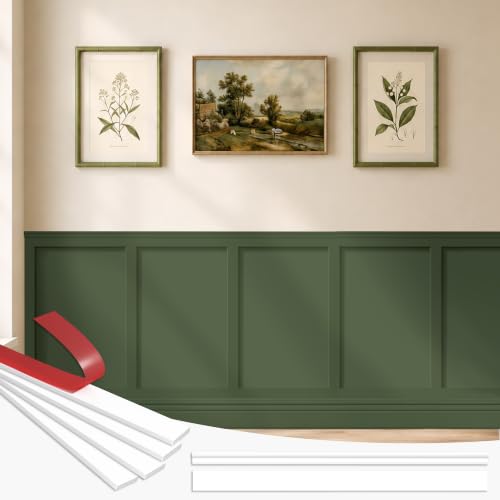
10-Piece Wall Panel Set:The wall panels includes 8 pre-finished trim pieces + 2 decorative edge strips. No need to purchase additional accessories, Covers 78.7"W x 39.3"H wall area (6.5 ft wide). All pieces feature a peel-and-stick design for easy installation.

【All-in-One Design】10 Premade molding trim slat + 2 decorative edge strip create instant board & batten walls,Adhesive is not included. Not waterproof – for interior dry areas only. Please pay attention measurements
Vinyl Board and Batten
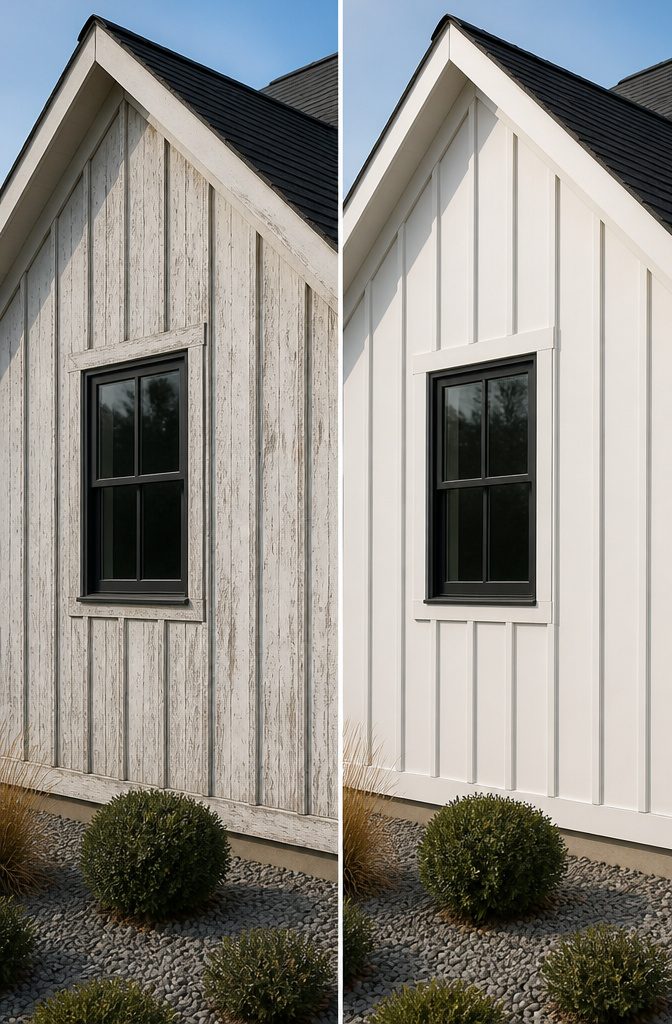
Vinyl board and batten siding resists rot, never needs painting, and washes clean with a hose. That near-zero maintenance burden makes it the practical choice for homeowners who would rather spend weekends on something other than scraping and repainting boards.
Vinyl costs less upfront than wood or fiber cement, and the material itself can last up to 25 years with nothing more than occasional cleaning.
What you trade for that convenience is depth. The shadow lines on vinyl profiles are shallower than real wood, and the difference is obvious up close.
Modern options come in realistic textures and colors, but the battens sit flatter against the wall and the boards lack the dimensional heft you notice from the curb.
From twenty feet away on a passing drive, most people will not clock the material. From your own front walk every morning, you might.
I would pick vinyl for a tight budget where the priority is getting the board and batten look without future upkeep costs.
For a full exterior on a starter home, it fits a real-world budget and a weekend timeline if you hire the install out, or a slightly longer one if you DIY.
I would skip it on a front elevation where the house sits close to the street and the shallow profile shows, or anywhere I want the authentic shadow play that makes this style distinctive.
Fiber cement costs more but delivers that depth; vinyl saves the money and the labor at the price of looking almost right rather than fully right.
Handcrafted and manufactured in the USA

Injection Molded Polystyrene Construction

Item Description: 17 1/2"W x 42"H Americraft Five Board (2 Batten) Exterior Real Wood Joined Board-n-Batten Shutters w/ Z-Bar (Per Pair), Ocean Swell
Fiber Cement Board and Batten
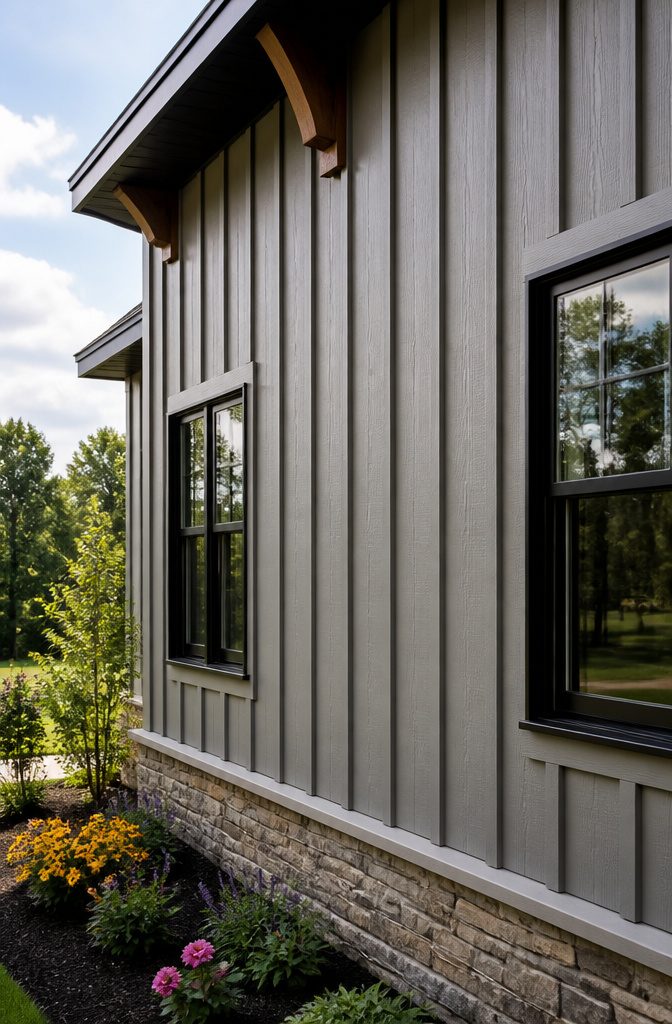
Fiber cement board and batten hits the mark when you want the shadow lines and grain of real wood without the upkeep calendar.
James Hardie and similar manufacturers engineer panels and 3/4-inch trim batten strips that lock together into the same vertical rhythm as traditional boards, and from the curb the difference is hard to call.
The material carries weight, literally. Panels run heavier than vinyl or engineered wood, so installation demands a crew that knows the fastening pattern and flashing details by heart.
Most contractors who handle fiber cement regularly charge more for labor, and the product itself sits above vinyl in price.
I would not attempt this one myself on a weekend; the learning curve is steep enough that botched cuts or gaps void the warranty and invite moisture behind the panels.
What buys back that upfront cost is the 15-plus-year repaint cycle. Wood board and batten asks for fresh paint every 5 to 7 years, which means three trips up the ladder for every one with fiber cement.
Over a 20-year window, the math shifts in fiber cement’s favor even if the initial invoice stings.
Add in resistance to rot, fire rating, and the fact that termites will not touch it, and this is the option I would save for if I planned to stay in the house long enough to skip two paint jobs.

Fitment: The siding hangers for hardie fit 5/16" thick siding board. Siding tools for Hardie fiber cement LP SmartSide Cedar lap siding board fit all standard-width siding planks including hardie board, old/ new fiber cement siding, vinyl siding and wood siding board.

Package Content: you will get 2 packs of concrete, each pack is about 2.2 pound per cubic yard (27 cubic feet); Add more for high impact or severe freeze or thaw areas

Package Content: you will get 4 packs of concrete, each pack is about 2.2 pound ;Add more for high impact or severe freeze or thaw areas
Engineered Wood Board and Batten
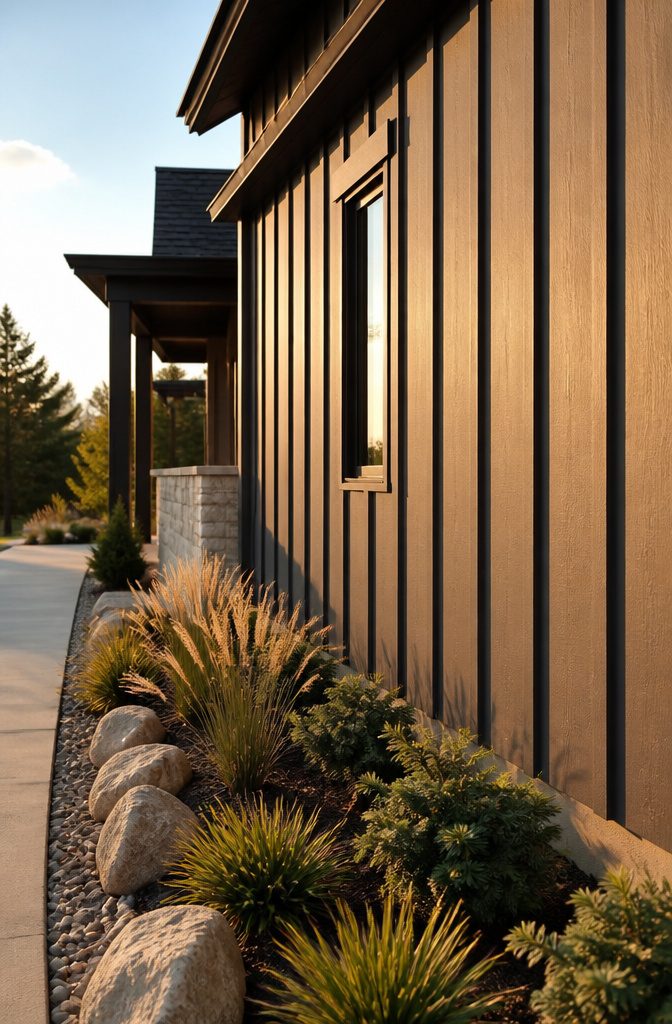
Engineered wood takes the grain and weight of real lumber and treats it with resins and wax to stand up to what solid cedar cannot. The result is about a 30-year lifespan with far less upkeep than traditional wood demands.
Panels like LP SmartSide use proprietary binders for resistance to hail, moisture, rot and termites, so you get the board and batten look without the twice-yearly inspections and repainting every 5 to 7 years that raw wood requires.
The savings come from installation as much as material. Engineered panels arrive uniform and stable, which means less culling for warp or crack, and cuts that stay true on the saw.
Exterior Portfolio and similar lines back their fade-resistant color with double lifetime warranties, so the finish outlasts what most homeowners would actually tackle on a weekend.
I would pick engineered wood for a full exterior project where I need the vertical shadow lines but do not want to become my own siding crew for maintenance seasons.
You are buying a system, not boards from the local yard, so color choice locks in at order and replacement pieces need matching stock.

Tru-Lock state-of-the-art locking system, Random seams
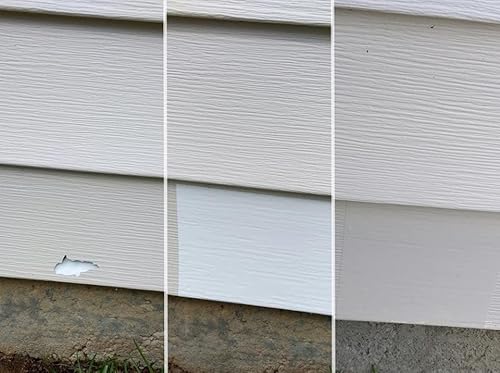
BUILT TO HANDLE REAL WEATHER – Engineered to perform reliably from 40°F to 130°F, this flexible PVC patch stays securely bonded through hot summers and freezing winters — suitable for both indoor and outdoor repairs on siding, stucco, and skirting.

𝗛𝗜𝗚𝗛, 𝗤𝗨𝗔𝗟𝗜𝗧𝗬 𝗗𝗘𝗖𝗢𝗥𝗔𝗧𝗜𝗩𝗘 𝗕𝗢𝗔𝗥𝗗 & 𝗕𝗔𝗧𝗧𝗘𝗡 𝗦𝗛𝗨𝗧𝗧𝗘𝗥𝗦: These Board and Batten home shutters offer a rustic ambiance and simplicity perfect for farmhouse and beach style homes. Please note that these shutters are non functional, and are decorative only.
Metal Board and Batten
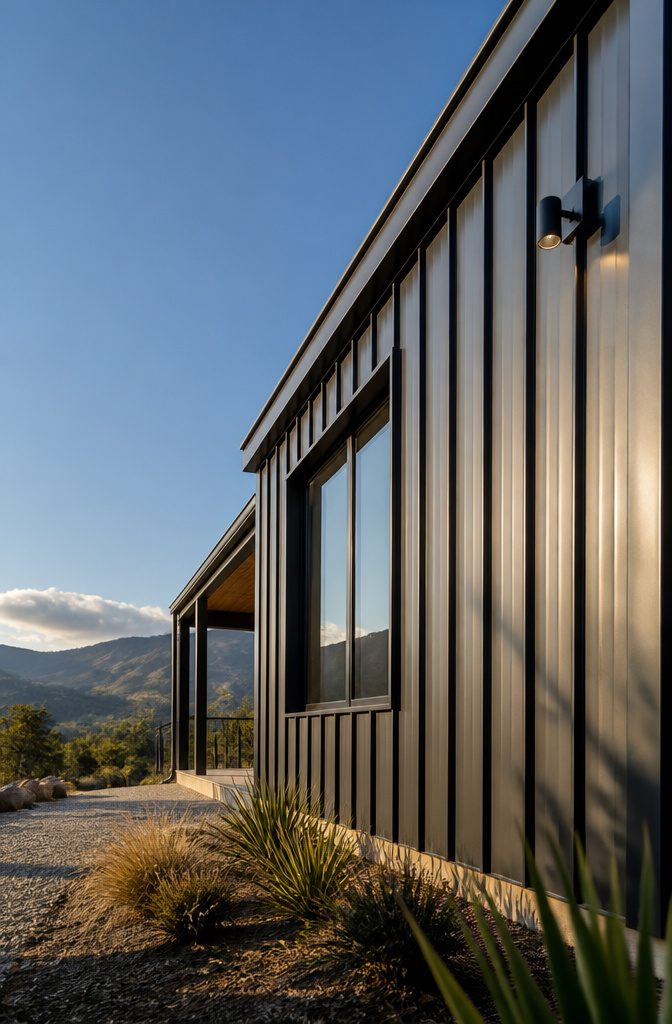
Metal board and batten exterior siding reads as contemporary and sharp, more industrial farmhouse than historical cottage.
Steel and aluminum panels run lighter than you’d expect, carry fire resistance, and shrug off weather that punishes other materials. The numbers that matter: $3.00 to $6.00 per square foot for panels, and ratings up to 170 mph for hurricane-force wind resistance.
The color range is where metal pulls ahead of wood.
Over a hundred factory finishes are available from some suppliers, and the coating technologies now include infrared-reflecting pigments that cut heat buildup and mineral-based UV formulations that resist fading without ever needing a paintbrush.
Maintenance drops close to zero; with correct installation, the material is set and left alone.
I would pick metal for a clean-lined, minimalist exterior or any house in a high-wind zone, but I would skip it for period-style homes where the slick surface fights the architecture.
The visual weight is the harder part. On a compact facade, full metal board and batten can read as siding wearing armor, not cladding with character.
Use it as the full treatment only when the house has the scale and simplicity to match it. On anything fussier or smaller, metal works better as an accent, paired with quieter materials, than as the dominant statement.

PREMIUM FLASHING TAPE - TapeManBlue 4 inch wide by 90 foot long roll of flashing tape is the perfect solution for all your door, window and other openings flashing needs. This 10 mil tape will give you a continuous water barrier and maintain performance with its durable, yet flexible construction. Use it for window flashing, door flashing or any other openings where weatherproof sealing tape is needed.

EXCELLENT INVESTMENT, EXTEND DECK LIFE: Wet joists will eventually lead to mold and rot. Joist Tape prevents water from getting under your deck and into the frame, extending the life of your deck. You no longer need to spend a lot of money on your deck, this affordable joist tape provides effective insurance for your deck infrastructure.

Split poly backing with butyl rubber copolymer adhesive peels quickly
Material Comparison
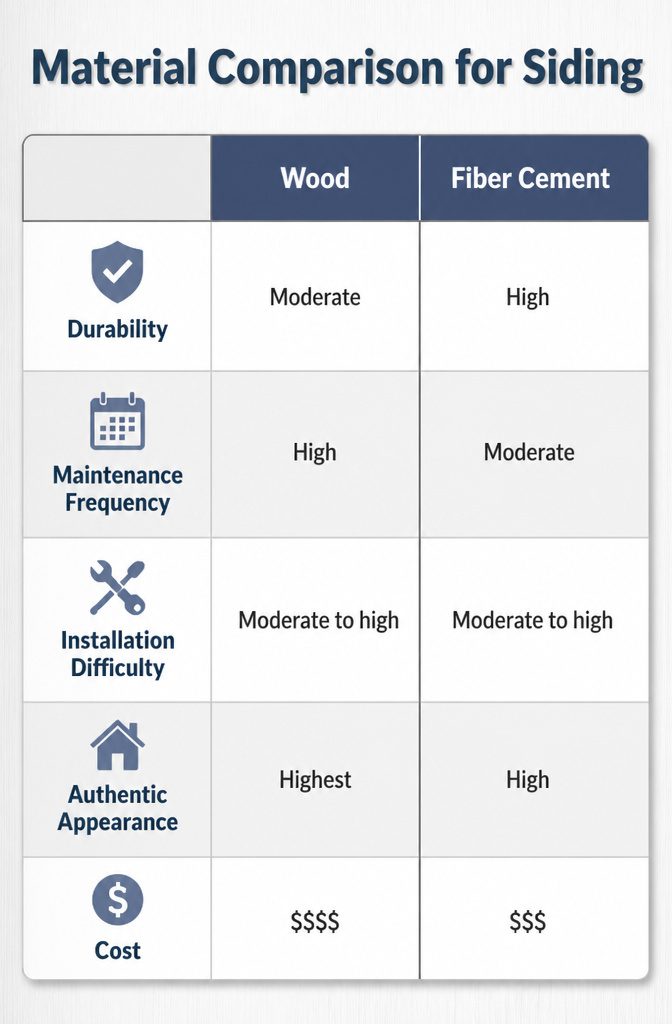
The material you choose for board and batten exterior siding sets how often you will be on a ladder with a paintbrush, and whether that is every 5 to 7 years or never.
Wood demands the most attention: twice-yearly inspections, repainting every 5 to 7 years, and immediate repair of any cracked or rotting boards. Fiber cement splits the difference with a 15-plus-year repaint cycle.
Vinyl and metal need little beyond occasional washing. Those maintenance differences translate directly into long-term cost and effort, so the table below lays out what each material asks of you.
| Material | Durability | Maintenance Frequency | Installation Difficulty | Authentic Appearance | Cost |
|---|---|---|---|---|---|
| Wood | Moderate (prone to rot if neglected) | High (inspect twice yearly, repaint every 5–7 years) | Moderate to high | Highest | $$$$ |
| Fiber cement | High | Moderate (repaint every 15+ years) | Moderate to high | High | $$$ |
| Vinyl | Moderate to high | Low (occasional washing) | Low to moderate | Lower (though modern textures improve this) | $ |
| Metal | High | Low (occasional washing) | Moderate | Moderate | $$–$$$ |
| Engineered wood | Moderate to high | Moderate | Moderate | Moderate to high | $$–$$$ |
On average, homeowners report spending $10.50 to $13.90 per square foot for professional installation, including the materials… recent popularity has driven the cost of board and batten materials up by around 10% each year for several years.
That 10% annual climb means delaying a project only makes it more expensive, and the material choice at the outset locks in your maintenance burden for decades.
For my own weekend-project budget, vinyl or fiber cement would win: vinyl if I need the lowest possible ongoing cost, fiber cement if I want the look of wood without the 5-year paint cycle.
Wood only makes sense if I am prepared to treat maintenance as a hobby, not a chore.
What Installation Costs
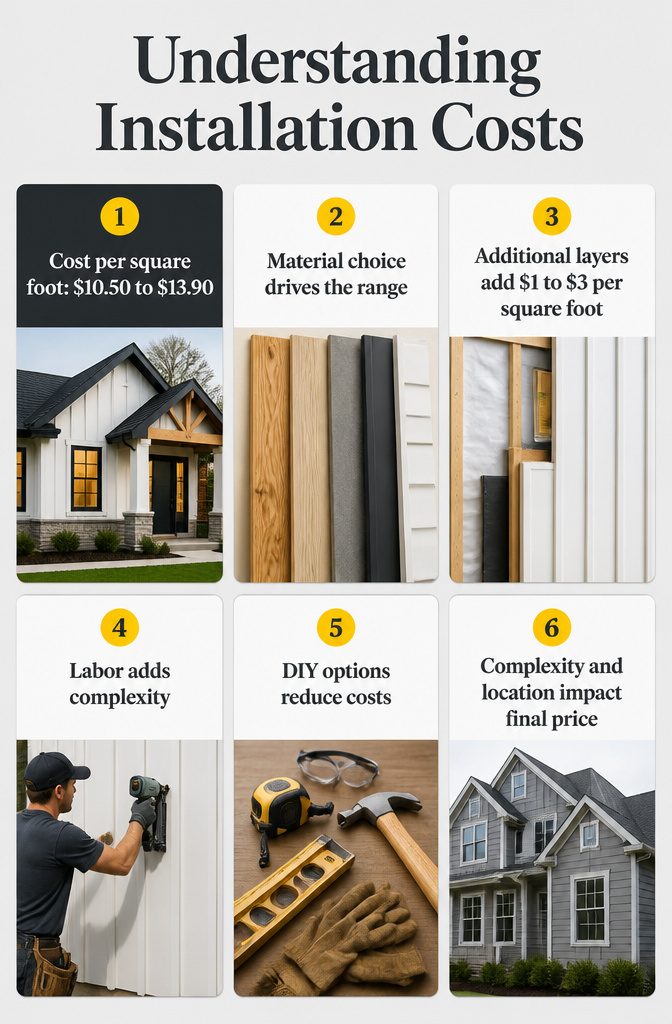
$10.50 to $13.90 per square foot is the installed average most homeowners land on for board and batten exterior siding, materials and labor together. That puts a 2,000 square foot house between $21,000 and $27,800 before extras come into the picture.
The spread from the low end to the high end has clear drivers.
Material choice is the big one. Wood, fiber cement, metal, vinyl, and engineered wood span roughly $0.75 to $10-plus per square foot on materials alone, and the gap widens once you factor in how each handles labor.
Vinyl and some engineered products arrive in sheet sizes that need cuts and fitting around windows and corners.
Wood demands more prep, more fasteners, and finishing with paint or stain after it goes up. Fiber cement sits heavier on the wall and moves different from wood, so the crew’s familiarity with it matters to the hourly tally.
DIY shifts the math most obviously. Stripping out labor drops the total toward that lower material-only figure, though I would only head that direction if the wall underneath is sound and the existing siding comes off clean.
Any sheathing repair sits outside these estimates entirely, so a teardown that reveals rot or water damage can erase the savings fast.
What the square-foot number does not include is the layer underneath. Housewrap, flashing at openings, corner trim, caulk, nails, and the finish coat for bare wood add another $1 to $3 per square foot.
Regional labor rates and complex wall lines with lots of windows push the installed price higher; simpler, flatter walls on a one-story garage land closer to the bottom end.
Using It as Accent or Full Exterior
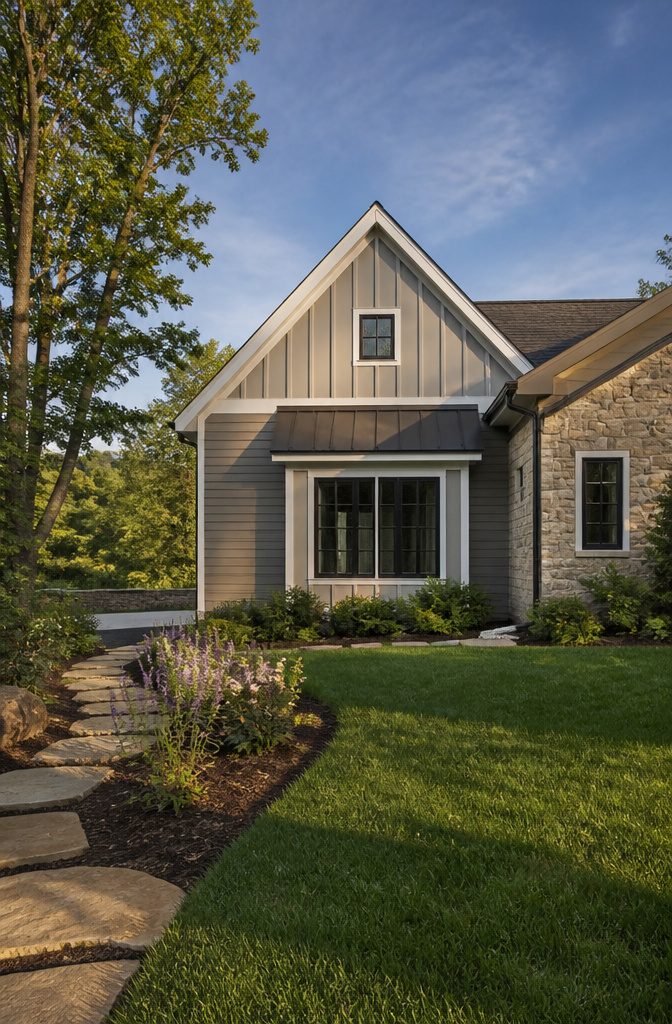
Board and batten exterior siding works as a full wrap or as a targeted accent, and the choice comes down to budget and how much visual weight you want.
Running it across the whole house gives a dramatic, cohesive look that sets you apart on a street full of horizontal clapboard, but vertical installation demands more precise stud-finding and alignment, so material and labor both run higher than standard lap siding in the same product.
For a full exterior, I’d step up to something like Hardie Trim boards rather than economy plywood, because the investment in coverage means you need the longevity.
The smarter move for most weekend budgets is using board and batten on gable ends, an entryway, or one feature wall.
You get the textural interest and the curb appeal bump without the premium of full coverage, and you can balance it against existing horizontal siding, brick, or stone for a custom look that still reads as intentional.
A small structure or single accent lets you save with pine plywood sheets cut into boards, since the visual trick comes from the battens spacing anyway.
If I were spending my own Saturday and maybe eight hundred dollars, I’d target the front gable and the garage door surround; full wrap stays on the list for the year the budget doubles.
Frequently Asked Questions
What is board and batten siding?
Board and batten exterior siding is alternating wide vertical planks and narrow strips called battens that cover the seams between them.
The boards go up first against the wall, then battens hide the gaps while adding shadow lines that give the exterior depth. This method started in Scandinavian barn construction and carries into modern farmhouses, cottages, and coastal builds.
How much does board and batten siding cost?
Professional installation of board and batten exterior siding averages $10.50 to $13.90 per square foot, materials and labor together.
A 2,000 square foot house runs between $21,000 and $27,800 before extras. Material choice drives the spread, with options ranging from roughly $0.75 to $10-plus per square foot on materials alone.
What materials can be used for board and batten siding?
Common materials for board and batten exterior siding include wood, vinyl, fiber cement, engineered wood, and metal. Wood offers authentic grain and warmth but demands the most upkeep.
Vinyl and metal need little beyond washing. Fiber cement and engineered wood split the difference on maintenance while approximating wood’s appearance.
Is board and batten siding durable?
Durability depends heavily on material choice.
Wood lasts about 40 years with proper care but is prone to rot and insect damage if neglected. Fiber cement and engineered wood resist moisture, rot, and termites.
Metal carries fire resistance and wind ratings up to 170 mph. Vinyl lasts up to 25 years with minimal maintenance.
Is board and batten siding cheaper than regular siding?
Board and batten exterior siding typically costs more than standard horizontal lap siding because vertical installation demands more precise stud-finding and alignment, raising both material and labor costs.
The 10% annual price climb driven by recent popularity also means delaying the project only makes it more expensive.
What are the disadvantages of board and batten siding?
The main disadvantages are higher cost than standard siding, the precision required for vertical installation, and material-specific trade-offs. Wood demands repainting every 5 to 7 years and constant vigilance against moisture and insects.
Vinyl sacrifices depth and shadow lines for low maintenance. Fiber cement is heavy and steep to install, with labor costs reflecting that complexity.
What type of wood is best for exterior board and batten siding?
Cedar and redwood are the traditional choices for wood board and batten exterior siding, valued for their natural resistance to rot and their grain patterns.
Cedar in particular can reach 40 years with proper care. Both take stain well if you want the grain visible, or paint if you prefer a solid color and tighter budget.