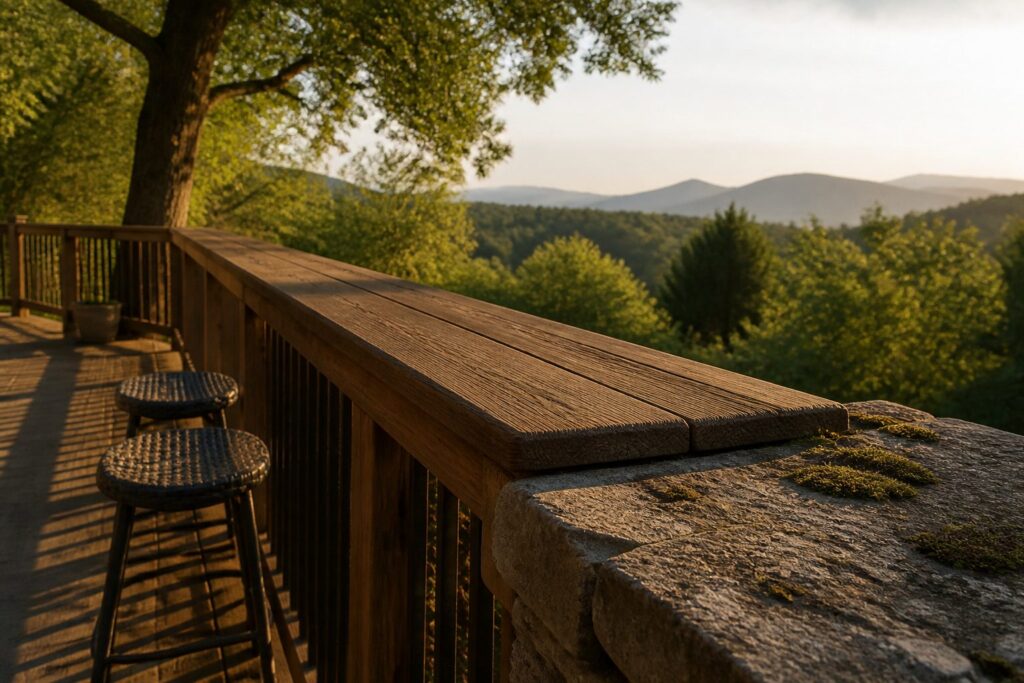
A deck railing bar top can run from a Saturday morning with a miter saw to a structural engineer’s review, depending on whether you land on cedar or stone.
The deciding factor is not budget alone but how much of your time you are willing to trade for permanence. Composite strips away every annual resealing; concrete demands four days just to strip the forms.
[link-whisper-related-posts]1. Classic Cedar Cap Rails
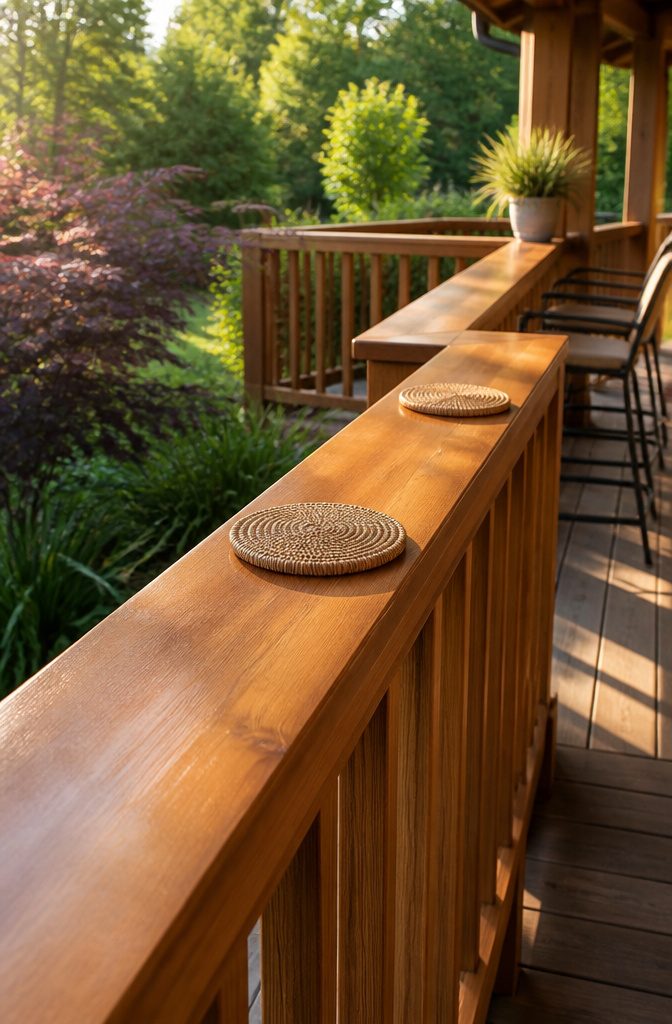
Cedar carries a warmth no composite can quite match, and for a deck railing bar top that reads as hand-built rather than store-bought, it is the material I would start with.
A cap rail 4 to 6 inches wide gives you the stability you need for an actual working surface; anything narrower and a wine glass starts to feel like a balancing act.
I would sand it smooth enough to lose the splinter risk but stop short of gloss, leaving some texture that grips a coaster.
The grain takes marine-grade sealer beautifully, and an annual coat of one is the maintenance I would commit to if you want to keep that honey tone.
Skip it, and the wood does not punish you; it simply drifts to a silver-gray patina that some homeowners prefer. That weathering is cedar’s honest character, not a failure.
For a weekend project with a miter saw and a few brackets, the straightforward cuts and single-screw mounting to a standard 2-by-2 baluster make this the option I would hand to any first-timer who owns a drill and a free Saturday.

★★ Unique Grooved Surface. ▼ ALUMINUM BALUSTER: Universal aluminum balusters provide a clean, stable and contemporary feel to your deck. Lightweight and never-rust alternative to wrought iron.

Premium Weather-Resistant Acacia: Crafted from 100% genuine acacia wood, known for its natural oils and dense grain, this table is built to withstand sun, rain, and humidity while maintaining a sophisticated look.

▼ ALUMINUM BALUSTER: Universal aluminum balusters provide a clean, stable and contemporary feel to your deck. Lightweight and never-rust alternative to wrought iron.
2. Composite Material Bar Tops
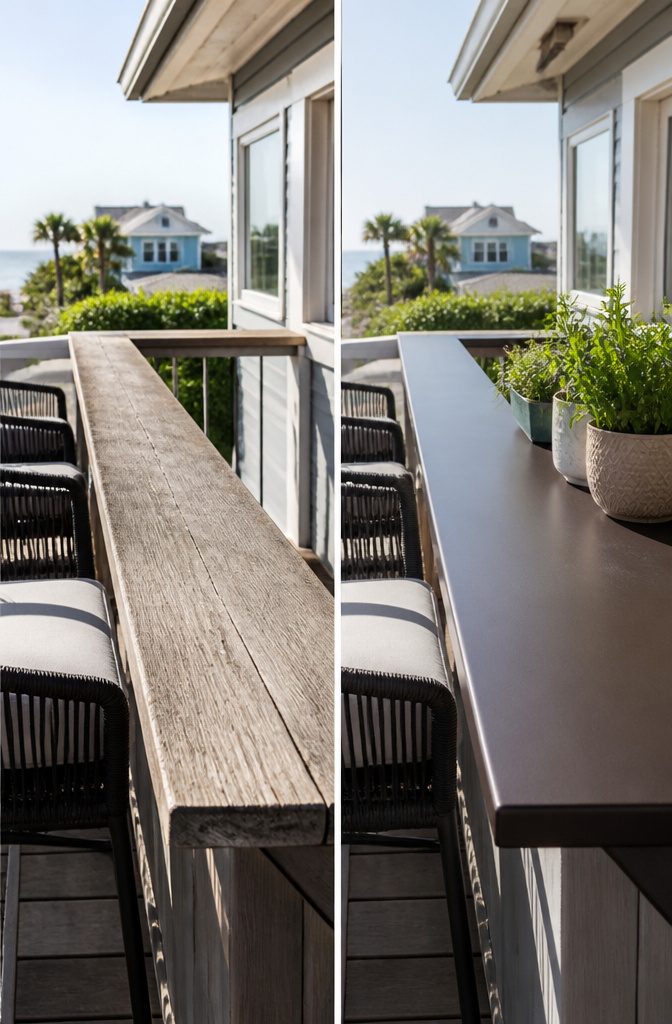
Composite bar tops take the surface I want, the look of finished wood, and strip away every weekend I would otherwise spend resealing it.
The material mixes recycled wood fiber with high-performance polymers, so the board arrives colored and grained straight through rather than wearing a surface veneer that can scuff or peel.
In coastal air or full sun, that matters: the same humidity that warps cedar in two seasons barely registers on composite, and the sealed surface never needs another coat of sealant after installation.
Brackets mount directly to existing 2" x 2" baluster posts with a single screw per bracket, which means the existing railing does most of the structural work.
The bar top itself drops in level and stays put without notching posts or pouring footings.
What you trade for that convenience is upfront cost, typically higher than pressure-treated lumber or even cedar, and a surface that looks uniform from end to end.
Some people find that consistency sterile; I find it predictable, which matters more on a project where I am the one doing the labor and the one catching the mistakes.
The real savings show up later. No sanding splinters, no staining between balusters, no replacing boards that cupped because I forgot to seal the underside.
Over five to ten years, the hours I do not spend on maintenance repay the higher purchase price several times over if my time has any value at all.
For a renter or a first homeowner who already juggles a job and a small child and one free Saturday in June, that equation usually points in one direction.

【Safety & High Impact Resistance 】– Prioritize the safety of your family and guests. This deck railing kit is designed to comply with strict IBC/IRC/ASTM building codes. The reinforced aluminum posts provide exceptional load-bearing capacity (withstands up to 500 lbs impact), preventing dangerous accidents.
★★ Unique Grooved Surface. ▼ ALUMINUM BALUSTER: Universal aluminum balusters provide a clean, stable and contemporary feel to your deck. Lightweight and never-rust alternative to wrought iron.
★★ Unique Grooved Surface. ▼ ALUMINUM BALUSTER: Universal aluminum balusters provide a clean, stable and contemporary feel to your deck. Lightweight and never-rust alternative to wrought iron.
3. Stone or Granite Rails
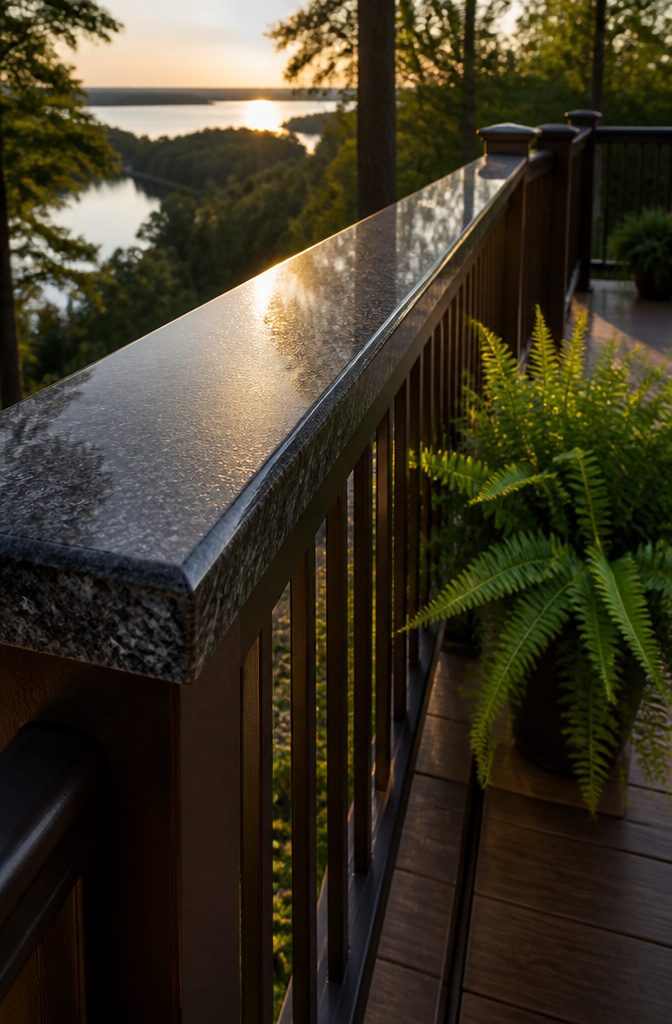
Stone or granite brings a permanent, built-in quality no other railing cap matches.
The thermal mass of granite or bluestone keeps drinks cold on its own, no ice bucket needed, which is the kind of detail that matters when you are standing at the rail in July.
That same density comes with real weight.
Most existing deck railings were not engineered for stone loads, so a structural check is non-negotiable; professional installation is the practical route here, both for the support and for getting the seams level across a run.
The finished bar top occupies about 10 inches of deck depth, measured from the inside face of the railing.
That is space you feel on a narrow deck, and I would skip stone entirely if my usable depth inside the rail was under six feet.
Seal it against wine and grease stains, pair it with cable or metal balusters to keep the look clean, and the surface outlasts the wood beneath it.
For a weekend budget and a DIY timeline, this is the wrong material. For someone building the deck around the bar, not the bar onto the deck, stone is the choice I would make.

Heavy-Duty Galvanized Steel — Built for Secure Level Connections: Made from strong galvanized steel with a protective black coating, these level railing brackets provide dependable support at key connection points while helping resist rust and corrosion outdoors. The durable finish stands up to rain, humidity, and seasonal weather and coordinates cleanly with Guwezoy railing panels, posts, gates, and accessories for a consistent, finished look.

Pair of brackets, 6 1/4-in D at base by 5-in H each

A CLEAN FINISHED LOOK: Weatherables Classic Brackets are designed to provide a finished look for straight railings that wrap around your porch, deck, or balcony. Made for those who need to split a straight, single rail kit, and in more than one place.
4. Reclaimed Wood Cap Rails
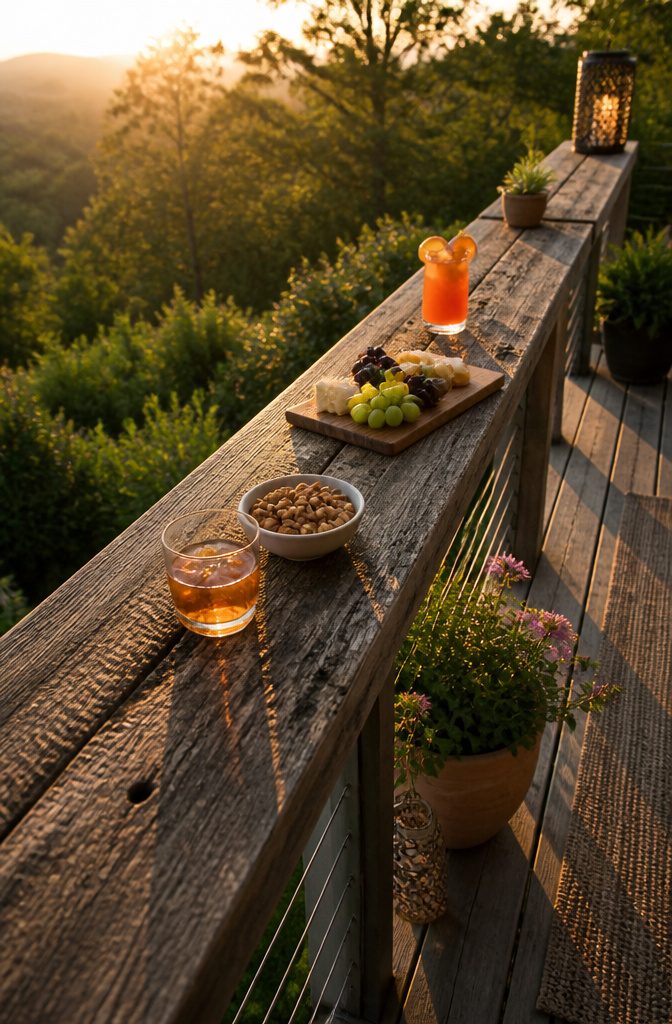
Reclaimed barn wood or vintage lumber brings instant history to a deck railing bar top, and the environmental appeal is real: you are keeping material out of a landfill while building something that no factory could replicate.
The weathered patina, old nail holes, and color variation tell a story that new boards simply cannot match. Old-growth reclaimed wood also carries higher density and tighter grain than most modern lumber, which translates to better natural durability outdoors.
The labor is where this material asks for honesty. Every board needs to be checked for hidden nails or staples before cutting, which means running a metal detector over the full length or hand-picking out fasteners with pliers and patience.
Then comes cleaning, possibly treating for insects, and sealing to protect against further weathering without erasing the rustic character.
The widths will be irregular, so each piece is its own puzzle rather than a uniform run you can rip to standard size.
For a weekend project, the extra hours matter. A reader who wants something quick and consistent would struggle here.
If the story of the wood matters to you more than the speed of the build, you get a bar top with genuine conversation value, not a surface that looks like it came from a catalog.

This product is easy to use

This Product Is Easy To Use

Metal wrought iron railing: high hardness and light weight; the stair column is made of high-quality fully wrought iron, coated with anti-rust coating, smooth surface, comfortable touch, durable.
5. Metal Top Rails
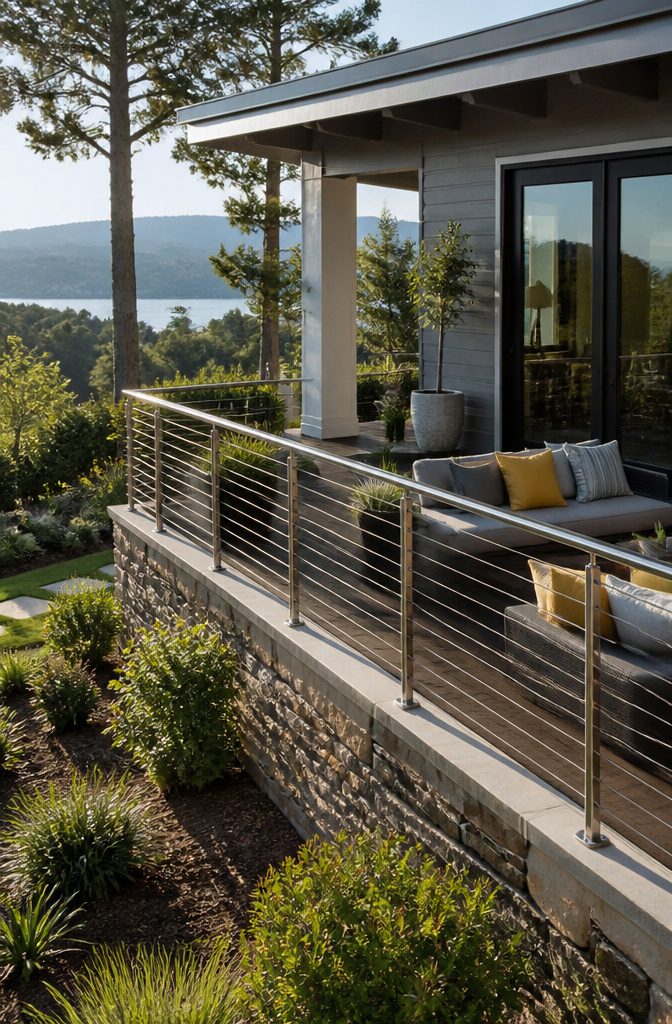
Stainless steel and aluminum cap rails give a deck railing bar top the clean, narrow profile that modern builds demand.
Stainless steel holds up longest against salt air, which makes it the practical choice for coastal decks where corrosion is the thing that ruins every other material in five years.
Aluminum never rusts either, and it stays lighter and cheaper, though it dents more easily if someone leans hard with a tool belt or drops a heavy grill grate.
The trade-off that matters on a summer afternoon is heat.
Metal in direct sun gets hot enough to notice, though sources note it stays cooler than dark wood options; still, plan the seating so guests are not gripping the rail for long stretches at midday.
For attachment, welding gives the sleekest line with no visible hardware, but it means hiring a fabricator and committing to the exact length.
Bolt-on brackets let a handy homeowner handle installation over a weekend and adjust if the deck settles or shifts.
Powder-coated finishes add color options beyond raw metal, which helps if you want the rail to read as an accent rather than industrial infrastructure.
Pair either metal with cable railing or glass panels below and the whole run stays visually light, more horizon than barrier.

MARINE SEALANT: Our liquid formula creates a UV-stable coating for protection against the elements, saltwater spray, and water damage. Marine is a protector for outdoor furniture, thermally modified wood, and boat docks. Marine is safe for use over open water and is non-hazardous to aquatic life. ** This product is NOT intended for hardwoods such as ipe, mahogany and teak. NOT intended for wood submerged under water or on wooden boats **

MARINE SEALANT: Our liquid formula creates a UV-stable coating for protection against the elements, saltwater spray, and water damage. Marine is a protector for outdoor furniture, thermally modified wood, and boat docks. Marine is safe for use over open water and is non-hazardous to aquatic life. ** This product is NOT intended for hardwoods such as ipe, mahogany and teak. NOT intended for wood submerged under water or on wooden boats **

WATER-BASED POLYURETHANE WOOD FINISH: Our sealant provides top-notch protection against wear and tear in high traffic areas. It's odorless and suitable for use on wood siding, log homes, swing sets, outdoor furniture, wooden deck and fence, and more
6. Glass Panel Bar Tops
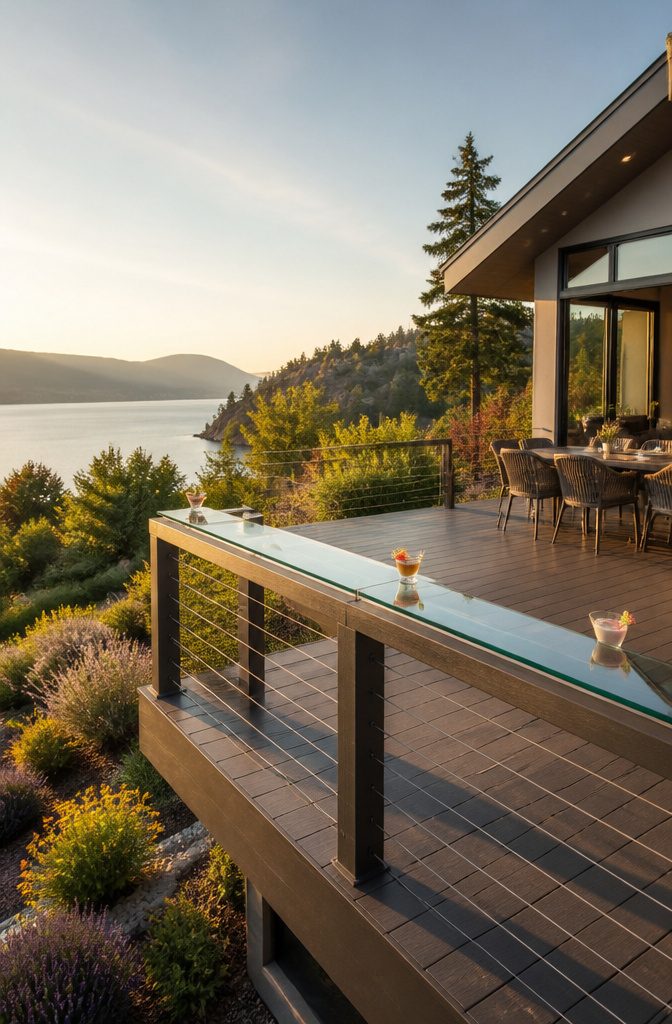
Tempered glass set into a deck railing bar top gives you the one thing solid railings steal back: the view. I would pick it for any deck facing water, trees, or a skyline you actually want to see over dinner.
The glass itself needs to be at least a half-inch thick to meet safety standards for impact and wind load, and the edges should be polished or beveled so the cap rail you drink against feels finished, not sharp.
Below the glass, cable railings or minimal metal posts keep that transparency going floor to ceiling. Frameless systems look the most contemporary; framed options trade a little sightline for easier installation.
Tinted or frosted glass cuts glare and adds privacy without turning your railing into a wall, though skip frosting if you chose glass for the open sightline.
The non-porous surface cleans fast, but it shows every fingerprint and water spot. In a busy entertaining space, that means wiping down before guests arrive, not after they leave.
Professional installation matters here: the support and sealing have to handle expansion, contraction, and weather without letting the panel shift. Done right, glass turns your railing into an architectural feature that frames what is outside instead of blocking it.

▼ ALUMINUM BALUSTER: Universal aluminum balusters provide a clean, stable and contemporary feel to your deck. Lightweight and never-rust alternative to wrought iron.

★★ Unique Grooved Surface. ▼ ALUMINUM BALUSTER: Universal aluminum balusters provide a clean, stable and contemporary feel to your deck. Lightweight and never-rust alternative to wrought iron.

HIGH QUALITY MATERIAL: Deck Railing Bracket is made of high strength ADC-12 Aluminum alloy cast as a whole, high temperature powder coating on the surface, durable corrosion resistance, waterproof, rust-proof, Suitable for connection and installation of outdoor Deck Wood Railing/Fence.
7. LED-Lit Bar Rail Systems
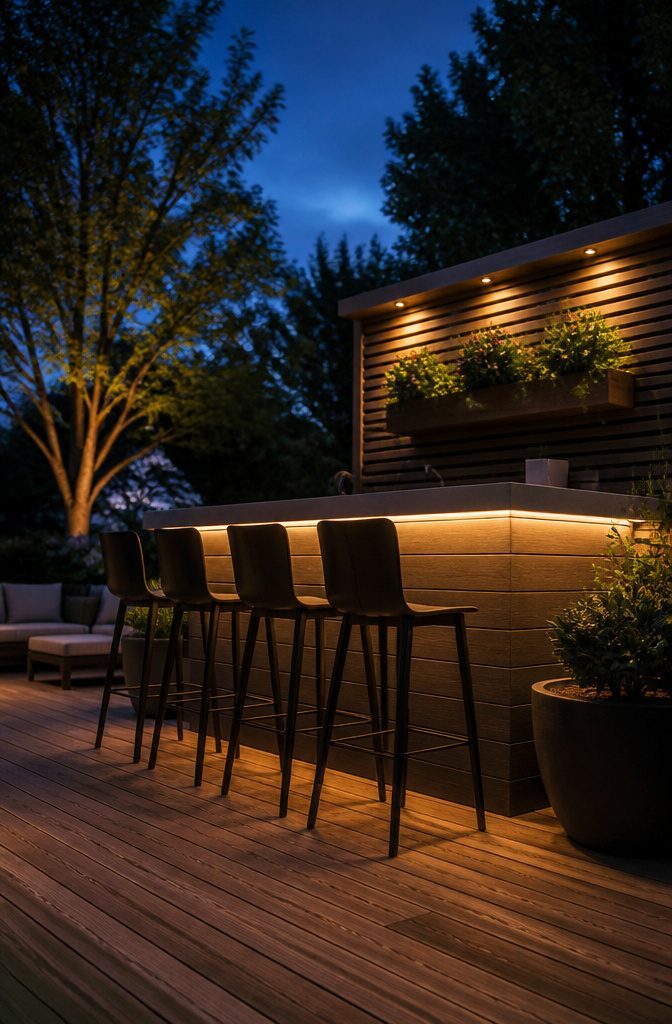
LED strip lighting tucked under the lip of a cap rail gives you run power before the top rail goes on, or you will be pulling boards back off to chase wires.
Low-voltage 12-volt systems are the standard for this kind of install; they keep you clear of the permit territory that 120-volt lines can trigger, and the smaller transformer hides in a weatherproof box either under the deck or inside a nearby exterior wall.
Fixtures need an IP65 rating or better to survive the seasons, and the transformer itself should sit somewhere dry even if the wiring is rated for wet locations.
Color-changing LEDs let you shift the mood from a Tuesday burger night to a Saturday dinner party, though I would skip the motion sensors on a railing bar.
They tend to flicker every time someone leans for a drink, and the point here is atmosphere, not security lighting.
Dimmable strips are the better spend. Solar-powered options exist, but in my view they rarely pull enough charge to look like anything after 9 p.m. on a cloudy week.
Plan the circuit so the transformer is accessible without dismantling anything; it is the part most likely to need replacing inside five years.

【Safety & High Impact Resistance 】– Prioritize the safety of your family and guests. This deck railing kit is designed to comply with strict IBC/IRC/ASTM building codes. The reinforced aluminum posts provide exceptional load-bearing capacity (withstands up to 500 lbs impact), preventing dangerous accidents.

ULTIMATE RUST & WEATHER PROTECTION:Crafted from premium heavy-duty stainless steel with a durable black powder-coated finish. These balusters are engineered to withstand harsh outdoor elements—rain, snow, sun, and humidity—without rusting, peeling, or corroding. Perfect for long-term use on porch railings and decking.

Easy Installation: Install in 3 simple steps with included accessories—no welding or cutting required! Pre-drilled holes and a positioning template ensure perfect alignment on wood, concrete, tile, or marble surfaces in under 30 minutes.
8. Curved or Angled Bar Sections
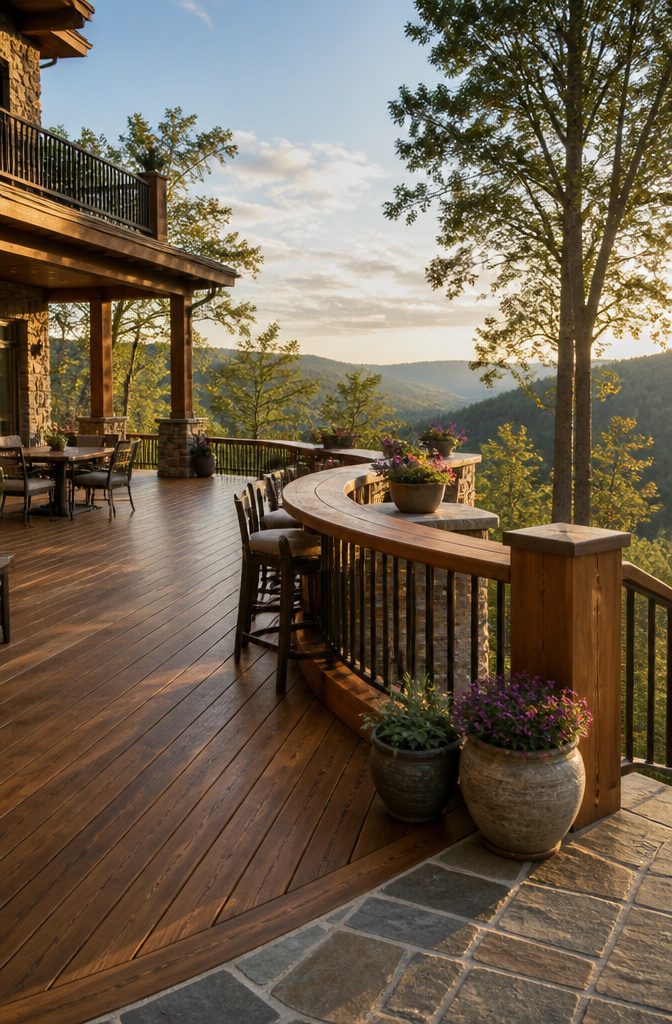
Curved or angled bar sections demand 10–20% extra material for the cutouts and trial fits that straight runs skip.
A radius of any size needs a jig, even a plywood template with a pivot screw, or the balusters wander and the bracket spacing turns uneven.
Angled corners are easier on paper: two mitered boards meet, end brackets land on each leg, but one side always ends shorter than standard because the post itself sits in the cut.
I would plan the bar top width before committing to any curve. A 6-inch cantilever looks graceful on a drawing and feeds nobody; 10 inches is the minimum that actually holds a plate and a drink.
Custom bending exists for metal rails, and specialized brackets from outfits like Cascade Manufacturing mount to a 2-by-2 post with a single screw.
Woodworkers can inlay species for contrast or set tile, though every added layer raises the rail height and can push the whole assembly past code.
The waste is real, the jigs take a morning to build, and the result belongs where people already stand: fire pits, hot tubs, the railing turn that frames the view.

【Sturdy & Durable Steel】IRENPORU Deck Railing Brackets Connectors made of 304 Stainless steel, Strong and Durable for long-term use. The surface is made of powder-coated technology, which has excellent Weather & Rust Proof performance. Much better than other nylon deck railing bracket connector

【Upgraded materials】The Deck Bracket is made of Strong Nylon 6/6, contains 20% sun-proof fiberglass. Our deck railing brackets have high hardness, not easy to crack, corrosion-resistant, suitable for both indoor and outdoor.

【Sturdy & Durable Bracket】SANKINS deck railing bracket is constructed from high-quality PP material, ensuring durability and long-lasting performance. The 2x4 railing bracket has qualified weight-bearing capacity with thick plastic and solid interior. Compared with other materials that are easily deformed and brittle to break, our Deck Railing Brackets is the most valuable choice in terms of corrosion resistance, safety and durability of use.
9. Bamboo Sustainable Rails
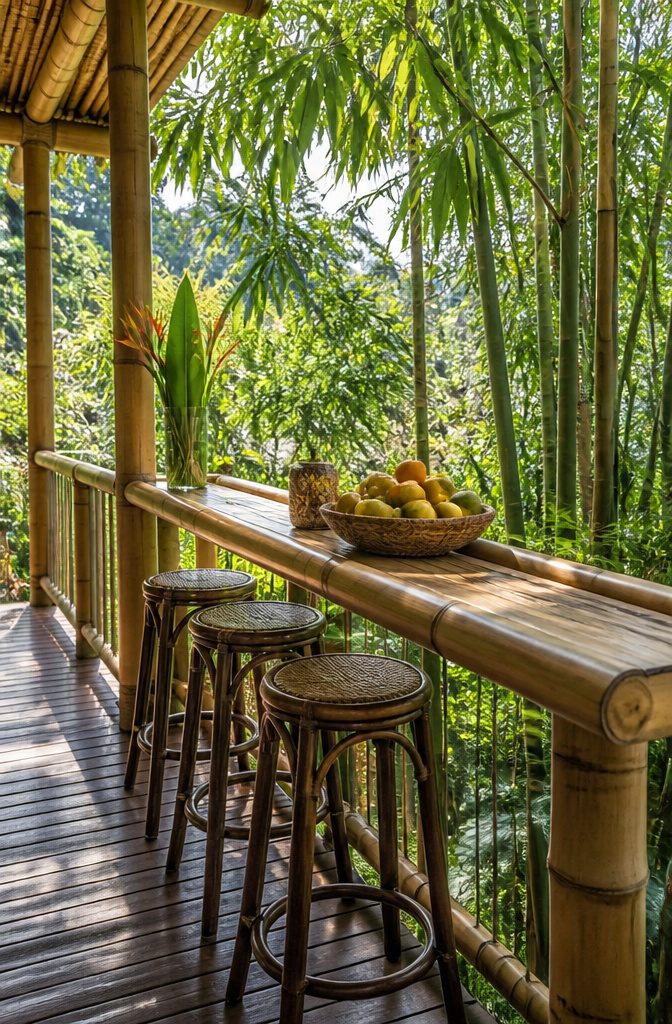
Bamboo grows to maturity in three to five years, and that speed is the whole reason it is sold as a sustainable hardwood alternative.
The material itself is a grass, not a tree, but strand-woven processing packs the fibers tight enough to reach densities that compete with oak or maple.
If you are choosing between natural and strand-woven for a rail cap that will live outside, strand-woven wins on weather resistance and dimensional stability.
The natural stuff shows the classic nodes and golden tone, but it moves more with humidity swings and asks for tighter maintenance.
The silica content in bamboo is what makes it hard on saw blades and router bits.
Cutting a rail profile through this material eats tooling faster than cutting spruce or even white oak, so budget for fresh blades mid-build or expect burned edges and tearout.
That same silica is also why most off-the-shelf deck sealers struggle to penetrate evenly.
Bamboo needs a sealer formulated for tropical hardwoods, applied more often than the can promises, or the surface turns gray and starts checking within a season or two.
Carbonizing the bamboo for a darker tone softens the material slightly, so the darker shade trades some of that celebrated hardness for looks.
I would strand-weave and seal heavy for a rail cap in full sun, and treat the eco-friendly sourcing as a genuine bonus rather than the primary selling point.
The sustainability is real, but only if you do the maintenance and keep the material out of ground contact.
Metal wrought iron railing: high hardness and light weight; the stair column is made of high-quality fully wrought iron, coated with anti-rust coating, smooth surface, comfortable touch, durable.
Metal wrought iron railing: high hardness and light weight; the stair column is made of high-quality fully wrought iron, coated with anti-rust coating, smooth surface, comfortable touch, durable.
Metal wrought iron railing: high hardness and light weight; the stair column is made of high-quality fully wrought iron, coated with anti-rust coating, smooth surface, comfortable touch, durable.
10. Tile-Topped Railing Bars
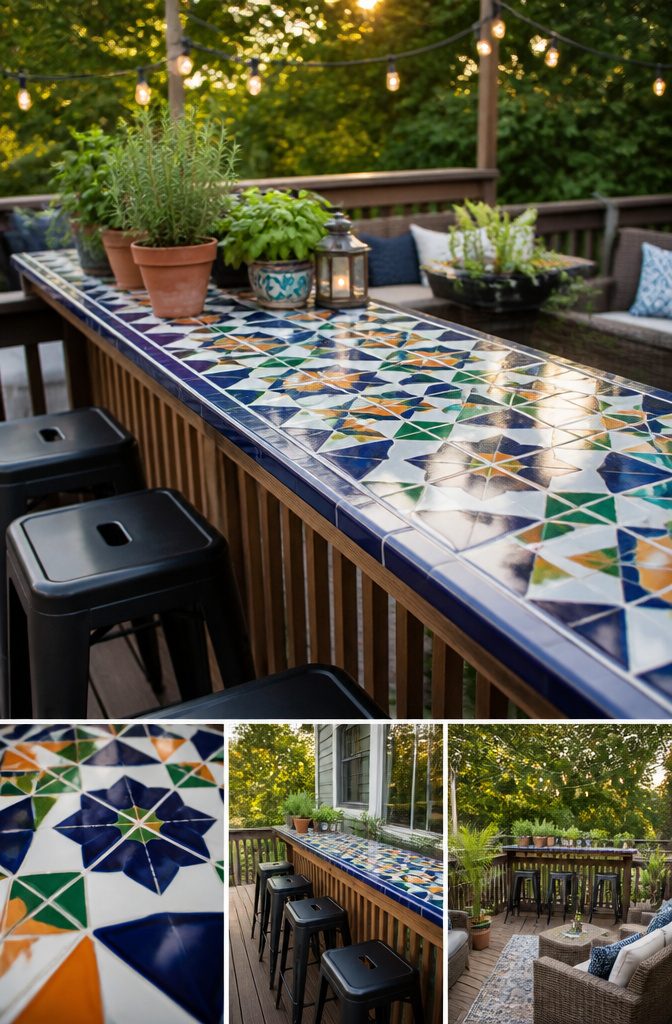
Ceramic or porcelain tile on a deck railing bar top gives you unlimited color and pattern choice, from geometric layouts to custom mosaic work that matches your siding or interior floors.
I would use cement backer board as the substrate, not plywood: the rigidity holds up, but the real win is that it will not swell or delaminate when grout eventually cracks in freeze-thaw cycles.
You still have to seal that grout every year, or water gets in and pops tiles off by spring.
The framing underneath has to keep baluster spacing under 4 inches, which the IRC requires anyway, but a tiled cap is heavier than wood and you need that full strength in the posts.
Weight adds up fast. Porcelain is denser than ceramic, and either one on backer board means you are asking more of the rail structure than a standard 2×6 cap ever would.
Curved sections are where I would skip tile entirely. Cutting curves in porcelain is slow, skilled work, and the waste is real.
Angled corners are fine; long straight runs are where tile earns its keep. If your rail has any meaningful radius, stone or a solid surface wins on install cost and on the final look.

MARINE SEALANT: Our liquid formula creates a UV-stable coating for protection against the elements, saltwater spray, and water damage. Marine is a protector for outdoor deck, thermally modified wood, and boat docks. Marine is safe for use over open water and is non-hazardous to aquatic life

MARINE SEALANT: Our liquid formula creates a UV-stable coating for protection against the elements, saltwater spray, and water damage. Marine is a protector for outdoor furniture, thermally modified wood, and boat docks. Marine is safe for use over open water and is non-hazardous to aquatic life. ** This product is NOT intended for hardwoods such as ipe, mahogany and teak. NOT intended for wood submerged under water or on wooden boats **

MARINE SEALANT: Our liquid formula creates a UV-stable coating for protection against the elements, saltwater spray, and water damage. Marine is a protector for outdoor furniture, thermally modified wood, and boat docks. Marine is safe for use over open water and is non-hazardous to aquatic life. ** This product is NOT intended for hardwoods such as ipe, mahogany and teak. NOT intended for wood submerged under water or on wooden boats **
11. Fold-Down Bar Top Sections
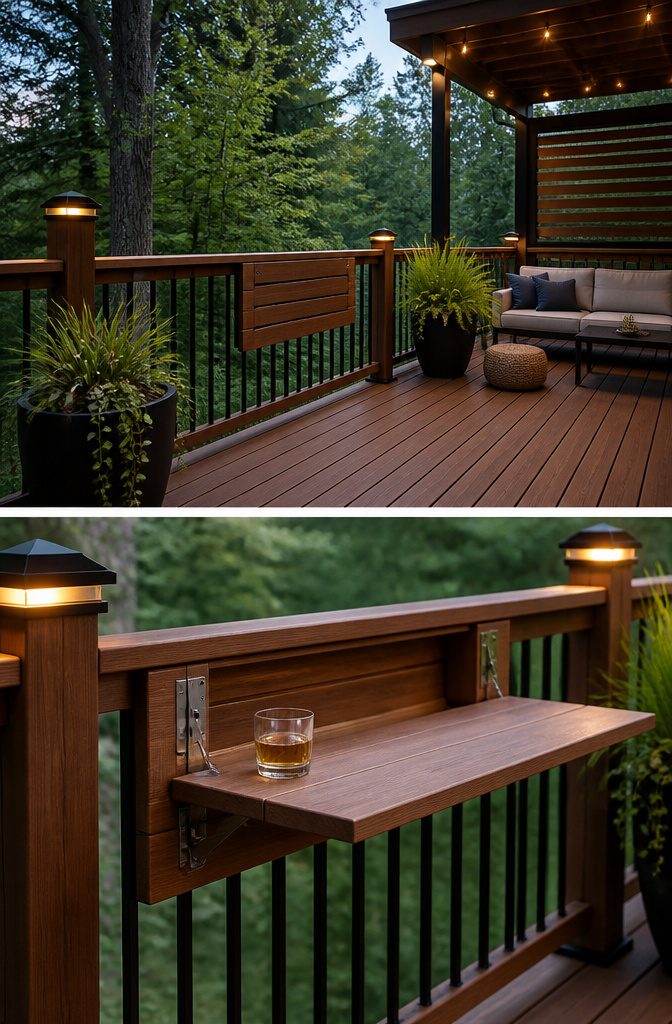
A hinged surface mounted to your deck railing gives you the full bar experience without claiming permanent territory.
3 feet of length per person is the standard for comfortable elbow room, but that math only works when the leaf is down; folded flat, the same rail disappears into sightlines you would otherwise lose to a fixed counter.
The hardware matters more than the lumber.
Cheap brackets corrode before the wood ever shows stress, so I would spend the extra money on steel with a powder coat finish rated for outdoor load, not interior-duty piano hinges that swell and bind after the first humid summer.
You also need a positive locking mechanism for the upright position, because a fold-down section that rattles loose in wind is a hazard to anyone below.
Chains or cables limiting the opening angle keep the deployed surface from sagging under a platter of burgers.
Finish both faces. The underside becomes visible when folded, and a raw plywood edge betrays the whole trick.
I would skip the add-on shelf underneath; it collects pollen and complicates the clean line that makes this solution feel intentional in a small space. For tight decks, this is the option that preserves flow without sacrificing function.
12. Live Edge Wood Slabs
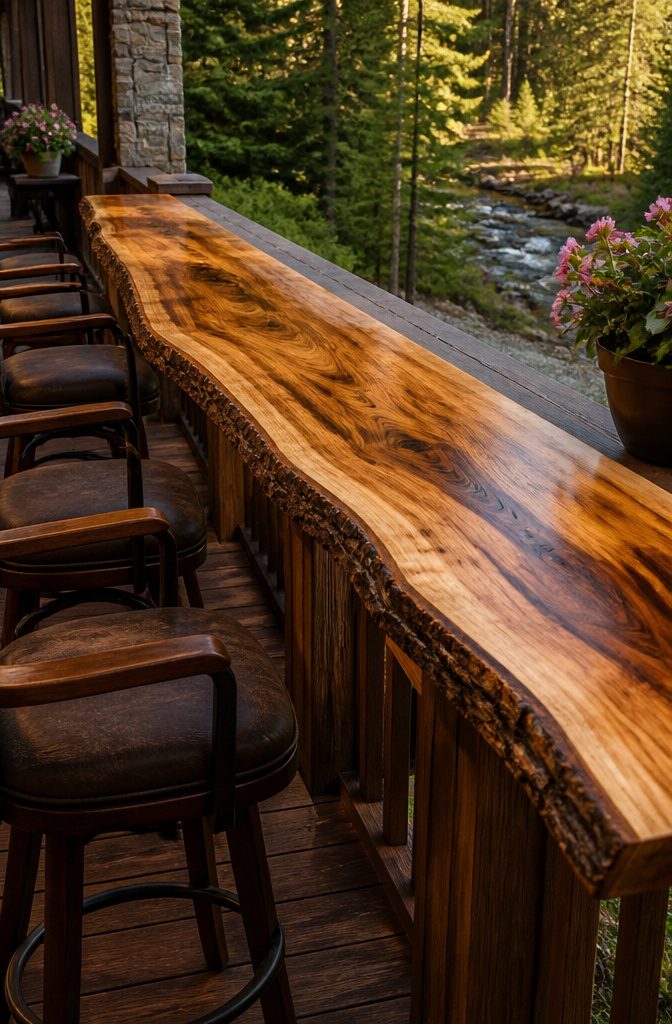
A single live edge slab with the bark left intact turns a railing into something closer to furniture than hardware.
Walnut, maple, cherry, or cedar each carry grain patterns no mill could repeat, and the preserved edge gives the board a shape that brackets built for dimensional lumber simply will not fit.
Plan the bracket placement after the slab is in hand, not before, because the irregular outline forces you to follow the wood rather than a standard span table.
The same organic shape that makes the piece striking leaves it prone to movement. Outdoor cycles of humidity and sun stress wood that was not fully dried, and live edge stock often retains more internal tension than flitch-sawn boards.
Resin fills for cracks, usually epoxy, keep the surface usable and catch light in a way that plain planed wood does not, but they also mark the spots where the slab is fighting itself.
A marine-grade sealer is non-negotiable here; without it, the bark edge loosens and the checking worsens. Even sealed, this is the kind of railing cap you maintain yearly, not the kind you bolt on and forget.
The slab turns the railing into a sculpture, but sculpture demands more care than a standard cap rail, and the time it asks for is the real cost.
13. Multi-Level Bar Rail Systems
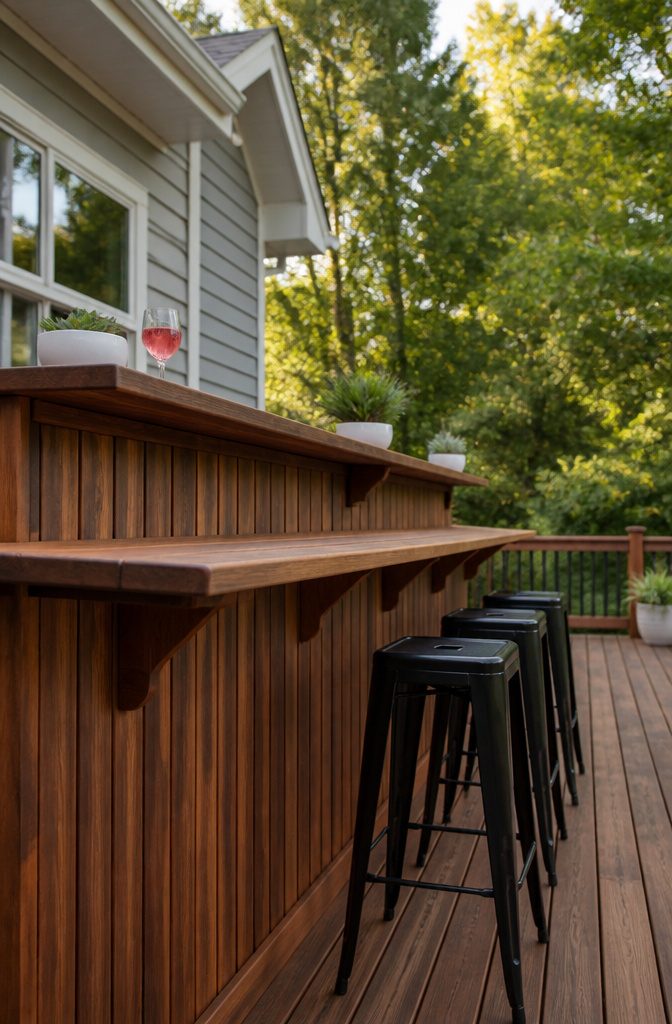
A stepped rail system gives you two usable surfaces where a standard top rail gives you one.
The upper tier sits at 36 inches minimum from the deck floor, the legal rail height that cannot drop at any point, not even on the lower tier.
That lower level lands around 30 inches, a comfortable ledge for seated guests working a plate or a laptop. Standing drinkers get the high rail; seated diners get the low one.
The brackets are where this option demands more precision than any other. Each tier needs its own continuous support, and the stagger creates twice the hardware and half the forgiveness for a measurement gone wrong.
One rail that reads 35 inches instead of 36 fails code; two rails with that error fail twice and waste the lumber.
14. Concrete Cap Rails
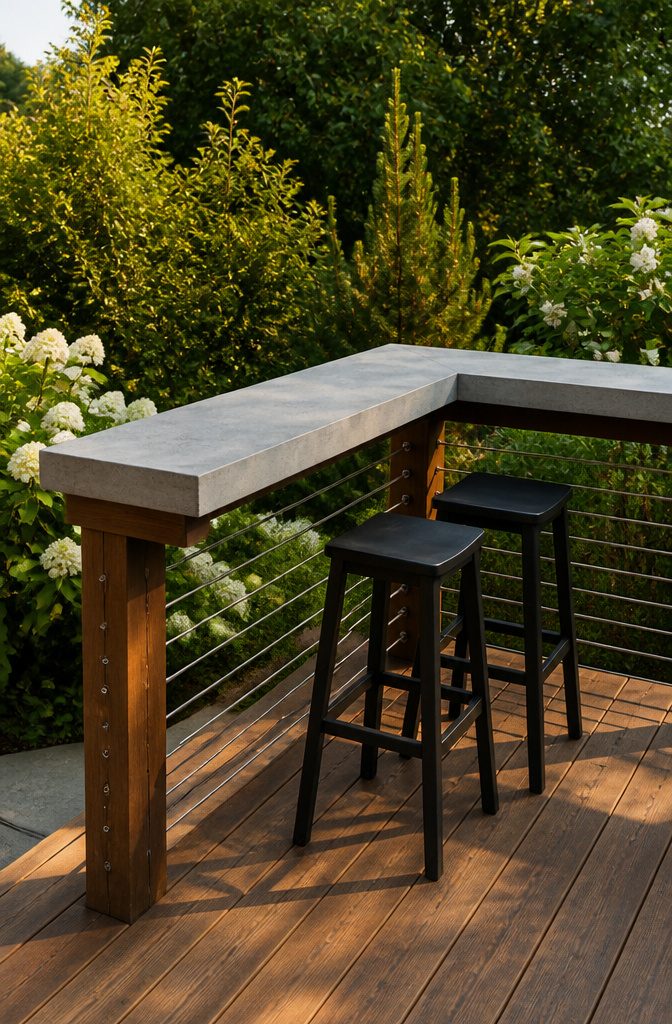
Poured concrete gives a deck railing bar top the thermal mass no other material matches.
The slab stays cool past noon on August days when metal or composite has turned too hot to touch, and that same density holds evening warmth after the sun drops.
I would pour in place rather than haul precast sections up to a second-story deck; the weight makes either approach a structural question, not just a preference.
A 2-inch profile needs rebar or wire mesh inside the form, otherwise the cured cap cracks across the span between posts.
I build the form from melamine-coated particleboard for a smooth finish, seal the joints with silicone, and oil the surface so the concrete releases clean.
The pour itself is quick, but the cure is not: four days before you strip the forms, another week before you bolt the rail through the cap, and a full month before the concrete has reached enough strength that I would lean my weight on it.
This is the heaviest option in the list.
Standard 4×4 railing posts were sized for a wood cap and a lateral hand load, not for several hundred pounds of distributed concrete plus the leverage of someone pressing down at the rail’s outer edge.
I would add a post at mid-span, or switch to 6×6 posts, or skip concrete entirely for an existing deck I did not frame myself.
The permanence is real, and so is the risk of a sagging rail line that never looks right again.
15. Custom Vinyl Wrap Bar Tops
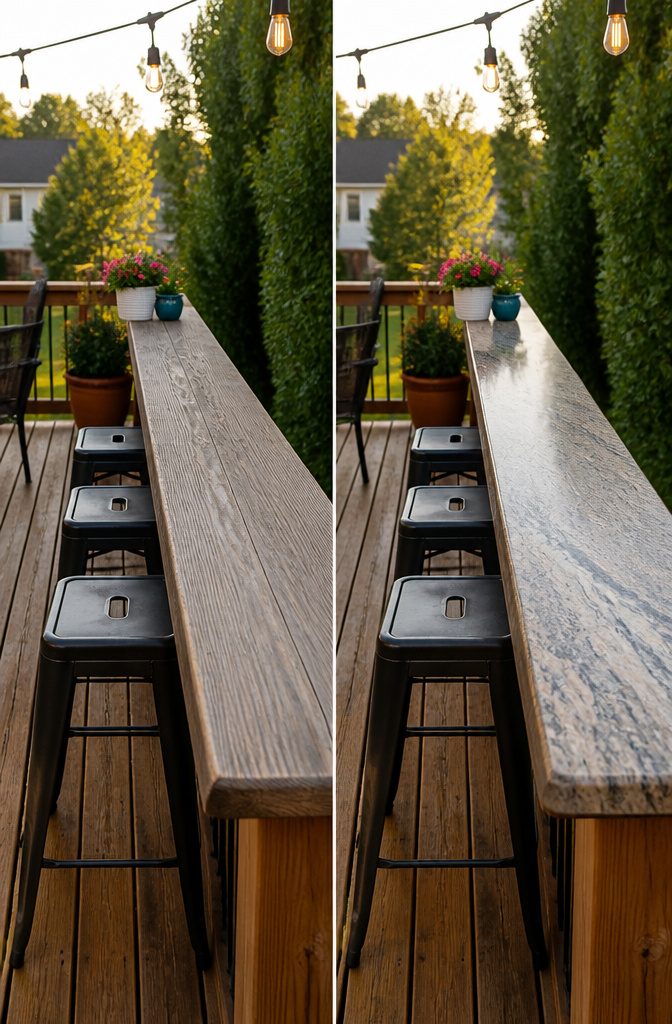
Printed vinyl over a sturdy substrate lets you run marble, teak, or custom graphics across a deck railing bar top without paying for the real thing.
Marine plywood or exterior-grade composite board works underneath; both handle the moisture but need sealed edges where the vinyl meets air.
I would wrap the vinyl around all four sides and finish with edge banding or a thin trim piece, because any lifted corner becomes a water entry point in the first season of sun.
The full surface replacement comes every three to five years in full sun, sooner if the bar sees heavy use or you skip the edge seal.
At roughly $40–$80 in materials for a 6-foot rail section, this is the cheapest path to an expensive look, but the lifespan trade-off is real.
I would use it for a rental I planned to leave in two years, or for testing whether I actually use the bar top enough to justify a permanent material later.
For a forever home, the re-wrapping chore gets old fast.
Materials Compared
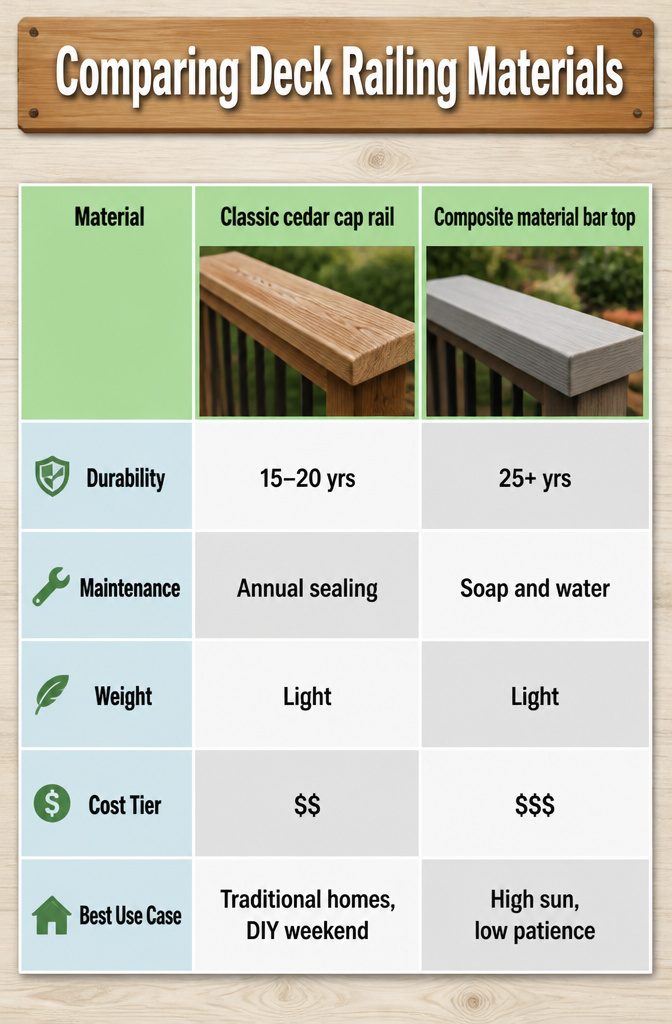
The 15 options fall into five material families that behave very differently under real use.
Cedar cap rails and reclaimed wood slabs both look warm, but cedar takes sealing every two years while reclaimed needs constant checking for old nail damage and inconsistent density.
Stone, granite, concrete and tile top out the weight chart at 40 to 80 pounds per linear foot, which sends you straight to structural verification before anything else.
Composite and vinyl wrap hit the low-maintenance sweet spot with 25-year fade warranties, though composite runs warm in direct sun and vinyl tops out around 42 inches wide before sagging.
Metal, glass and LED systems lean modern and coastal, but the powdercoat on aluminum scratches harder than stainless, and glass needs weekly wiping to look intentional rather than neglected.
Bamboo and live edge wood carry story value; bamboo is harder to source in lengths over 6 feet, and live edge needs shop time to true the bark line into a functional edge.
| Material | Durability | Maintenance | Weight | Cost Tier | Best Use Case |
|---|---|---|---|---|---|
| Classic cedar cap rail | 15–20 yrs | Annual sealing | Light | $$ | Traditional homes, DIY weekend |
| Composite material bar top | 25+ yrs | Soap and water | Light | $$$ | High sun, low patience |
| Stone or granite rail | Lifetime | Sealant every 3–5 yrs | Heavy | $$$$ | Permanent kitchens, ground-level decks |
| Reclaimed wood cap rail | Variable | Inspect and patch often | Light to medium | $$–$$$ | Rustic aesthetic, experienced DIYer |
| Metal top rail | 30+ yrs | Touch-up scratches | Medium | $$–$$$ | Modern lines, salt-air climates |
| Glass panel bar top | 20+ yrs | Weekly cleaning | Medium to heavy | $$$$ | Unobstructed views, no kids |
| LED-lit bar rail system | 10–15 yrs | Electrical check, bulb swap | Light | $$$ | Entertaining after dusk |
| Curved or angled bar section | Matches parent material | Matches parent material | Matches parent material | +20–40% labor | Custom fit to rail geometry |
| Bamboo sustainable rail | 10–15 yrs | UV-protective oil | Light | $$ | Eco-priority builds, covered areas |
| Tile-topped railing bar | 20+ yrs | Grout sealing | Heavy | $$–$$$ | Mediterranean or Spanish style |
| Fold-down bar top section | Hinges wear first | Lubricate, check hardware | Light when stowed | $$ | Small balconies, 10-inch overhang |
| Live edge wood slab | 15–25 yrs | Epoxy fill, re-oil | Medium to heavy | $$$–$$$$ | Statement piece, covered deck |
| Multi-level bar rail system | Matches parent material | Matches parent material | Heavy | $$$$ | Split-level yards, built-in seating |
| Concrete cap rail | Lifetime | Seal, watch freeze-thaw | Heaviest | $$–$$$ | Industrial look, substantial structure |
| Custom vinyl wrap bar top | 10–15 yrs | Replace wrap, clean adhesive | Light | $–$$ | Renter-friendly, temporary upgrade |
A 6-inch overhang is the working minimum for knee clearance; anything less and guests stand at your rail like they are ordering from a window.
Most of these install over existing 2×4 or 2×6 rail caps with carriage bolts or lag screws, but the heavy trio of stone, concrete and multi-level systems may need sistered joists below.
That structural check is $200 or a weekend of head scratching, not optional math.
Installing Over Existing Railings
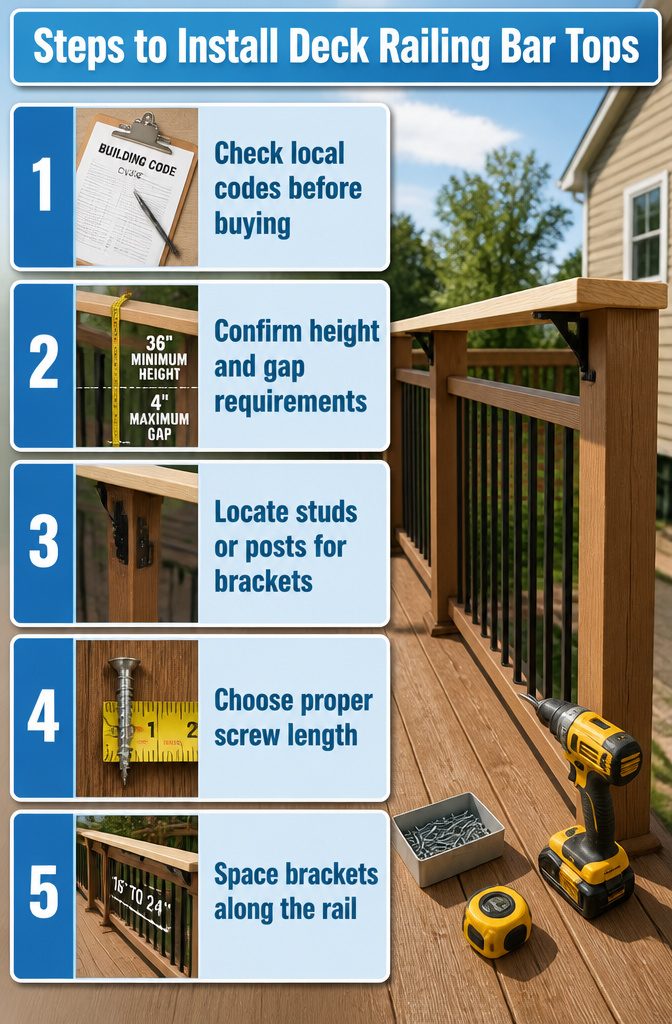
- Check your local code before you buy anything. Most deck railing bar tops do not require permits, but any modification that changes rail height or structural load can trigger inspection. I would call the building department rather than guess; an afternoon on the phone beats tearing it out later.
- The 36-inch minimum height and 4-inch maximum gap are non-negotiable. Your bar top must sit above a rail that already meets this, or the combined height still clears 36 inches from deck floor to top surface. The 4-inch rule applies to any new gap you create between balusters, bottom rail, or decking.
- Locate studs or posts for every bracket. On a wood rail, I drive screws into the structural posts behind the balusters, not just the cap rail. For metal or composite systems, use the manufacturer’s bracket or a surface-mount L-bracket with stainless steel hardware.
- Choose screw length to bite at least 1 inch into solid wood or structural post material. I prefer stainless steel or coated deck screws; plain steel rusts and stains the cap within two seasons.
- Space brackets every 16 to 24 inches along the rail span. A 4- to 6-inch wide bar top needs that support to hold drinks without flexing. I would rather over-bracket than watch a full cocktail slide toward the neighbor’s yard.
Sizing Your Bar Top to the Space
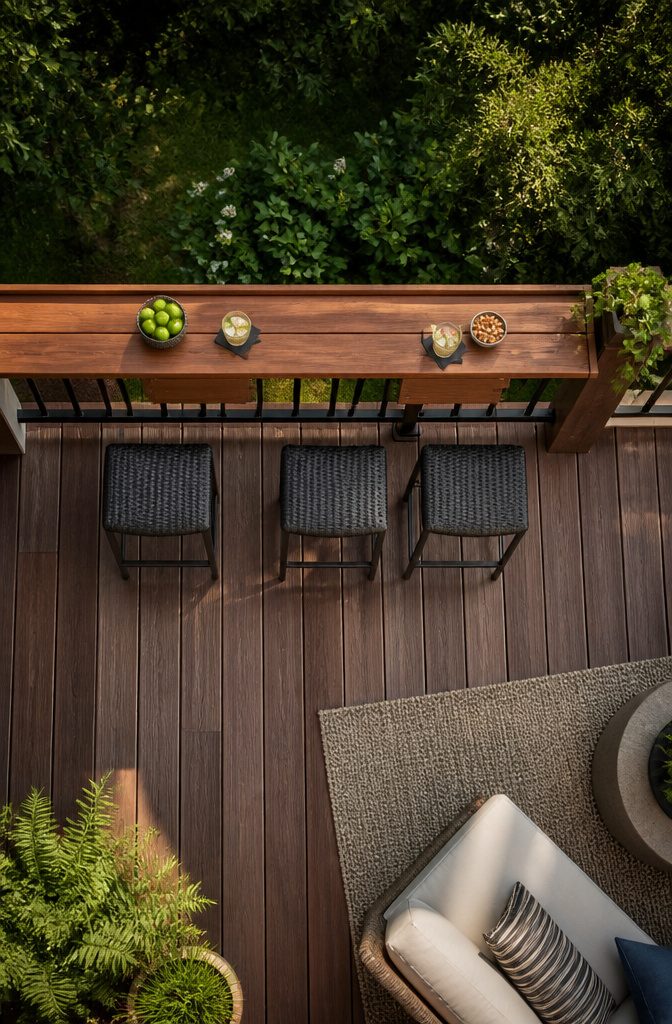
A deck railing bar top only consumes about 10 inches of space outward, but that narrow footprint still changes how people move through the area.
Three feet of bar length per person is the baseline that keeps elbows, drinks, and plates from colliding, and the 10-inch ledge depth means you’re not sacrificing the full span of a standard countertop.
The real trap is the deck that looks generous in a photo and turns cramped at the party. A 6-foot bar reads as compact until three guests claim their 3-foot stations and suddenly half the rail is a dead end.
I always walk the traffic path before committing to a length: does someone behind stool sitters still reach the grill or the steps without ducking?
If the answer involves squeezing past, the bar is too long for the deck or the layout needs to rotate.
Fold-down sections solve this cleanly. Hinged with piano brackets, the surface drops flush against the rail when it’s just you and a coffee, then pops out for the cookout.
You’ll sacrifice a few inches of usable depth compared with a fixed top, and you need to finish both faces since the underside becomes visible when stowed.
For renters or anyone whose deck is closer to a landing pad than a lounge, I’d pick the fold-down every time. It reclaims the area without asking you to store furniture elsewhere.
Frequently Asked Questions
What’s the ideal width for a deck railing bar top?
Four to six inches gives you enough surface for a wine glass without feeling like a balancing act, though 10 inches is the minimum if you want room for a plate and a drink together.
Anything narrower than 4 inches sacrifices real working space.
Do railing bar tops require special building permits?
Most don’t require permits on their own, but you should verify local codes before modifying railing height or adding weight that changes structural requirements.
LED systems with low-voltage 12-volt wiring stay clear of permit territory, while 120-volt lines can trigger inspections.
How do I weatherproof wooden railing bar tops?
Sand smooth enough to lose splinters but stop short of gloss so coasters grip, then coat with marine-grade sealer annually including the underside. Skip the annual coat and cedar drifts to silver-gray; it does not fail, just changes character.
Can I add bar tops to existing railings?
Yes, most install directly over existing rails using brackets with a single screw into a standard 2-by-2 baluster post. Composite, cedar, and metal options all drop in level without notching posts or pouring footings.
What materials work best in coastal environments?
Stainless steel holds up longest against salt air, followed by composite and properly sealed hardwoods like cedar. Stone also performs well but demands structural verification first; aluminum works too though powder coat scratches more easily than stainless.
What is the top of a deck handrail called?
The cap rail, which becomes a working bar surface when widened from the standard 2-inch profile to 4 or 6 inches for holding drinks.
What can I use for an outdoor bar top?
Cedar, composite, stone, granite, reclaimed wood, stainless steel, aluminum, glass, tile, concrete, bamboo, vinyl wrap, or live edge slabs each trade different strengths: wood warms, composite shrinks maintenance, stone and concrete add weight and permanence, metal and glass read modern.
What to use for a deck railing top?
Match the material to your timeline and climate: cedar or composite for weekend DIY, stone or concrete for permanent kitchens on verified structures, stainless or glass for coastal and view decks, reclaimed or live edge when story matters more than speed.
What is a cocktail rail on a deck?
A widened cap rail, typically 4 to 6 inches, that turns the top of the railing into a usable ledge for drinks and plates without adding separate furniture.
It projects about 10 inches from the inside face of the railing and pairs with bar stools below.