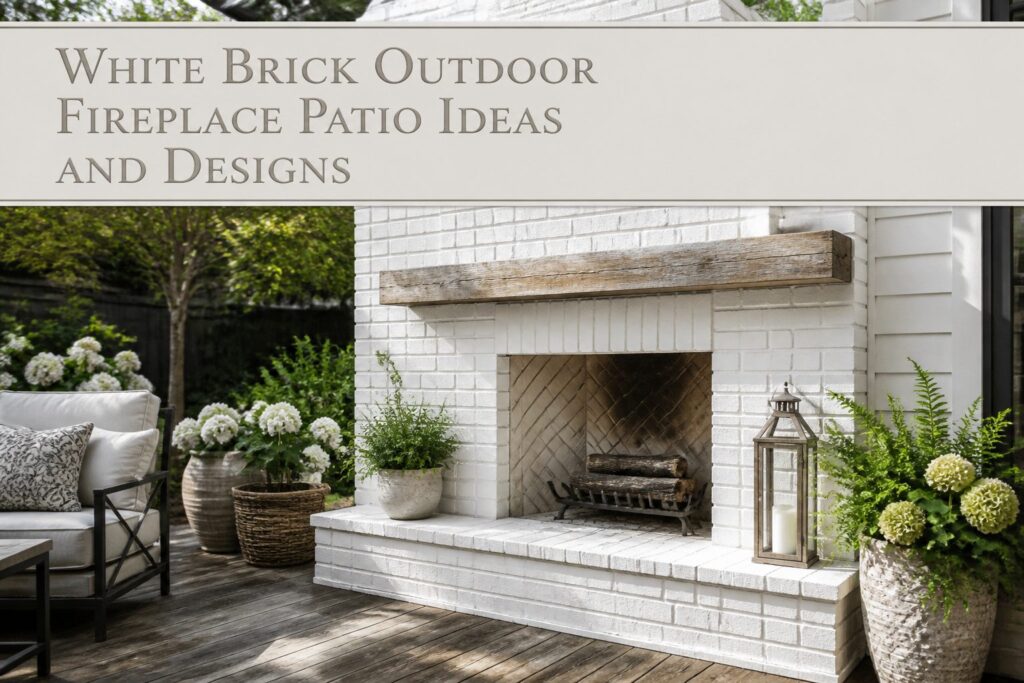
A white brick outdoor fireplace patio is a permanent masonry hearth built into your outdoor living space, finished in white brick to keep the area feeling open and bright.
The catch is upkeep: painted brick needs touch-up every two to three years outdoors, especially around the firebox where heat and moisture stress the finish.
Brick-Anew’s Frosted Sunshine paint kit handles this specific color, formulated for brick’s absorption rate rather than sitting on the surface like standard latex.
[link-whisper-related-posts]Gray or White Painted Brick
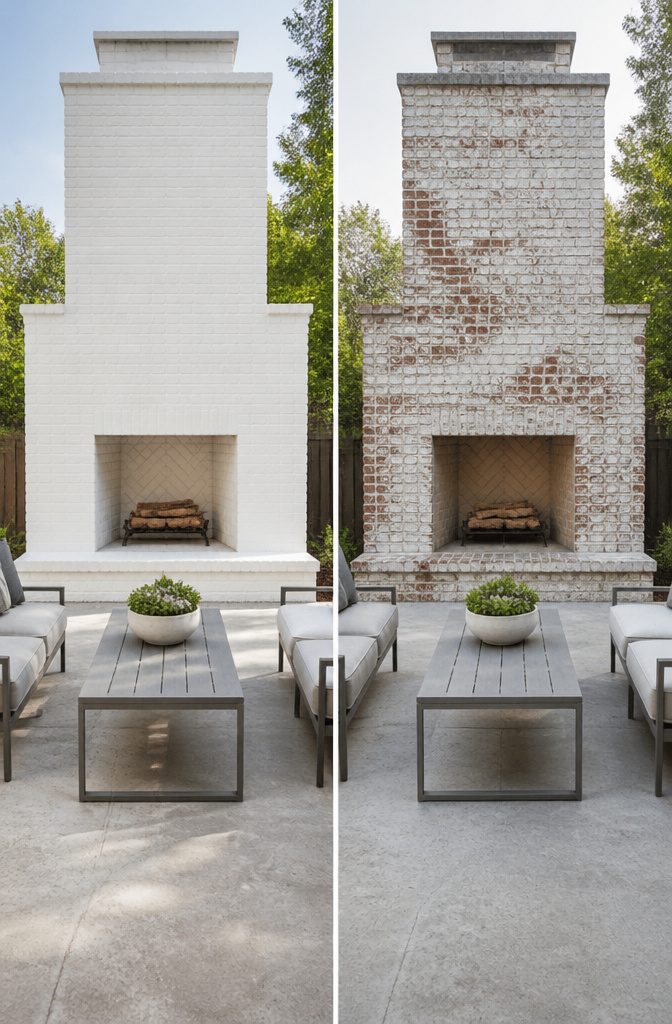
Painted brick gives an outdoor fireplace a surface that reads as intentional architecture rather than leftover construction material.
White and gray work especially well on patios because they reflect daylight instead of absorbing it, which keeps the seating area feeling open even when the fireplace mass is substantial.
Coastal setups and modern minimalist spaces both benefit: the same color that reads as breezy near water turns crisp and gallery-like against concrete or steel furniture.
For an existing brick fireplace that needs updating, Brick-Anew’s paint kit in Misty Harbor or Frosted Sunshine handles the two most useful tones.
Misty Harbor is the gray, and it disguises mortar variation without looking like a coat of primer. Frosted Sunshine is the white, and it lightens the brick without the artificial brightness of standard exterior paint.
Both are formulated for the texture and absorption rate of brick specifically, which matters because standard latex sits on the surface and chips at the edges of the firebox opening.
I would choose paint over natural brick when the existing color fights the patio furniture or when the mortar is stained in ways that power washing won’t fix.
The trade-off is upkeep: painted brick needs touch-up every two to three years in outdoor conditions, especially on the firebox surround where heat cycles and moisture stress the finish.
Natural brick weathers invisibly; painted brick weathers visibly, and that visibility is the cost of the cleaner look.
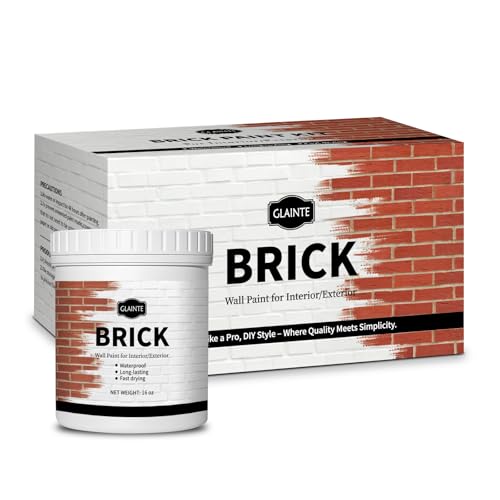
Multifunctional White Paint Set:Without the need for tedious polishing and priming steps, Brick Paint can be applied directly to a wide range of surfaces such as concrete,...
Classic Red Brick
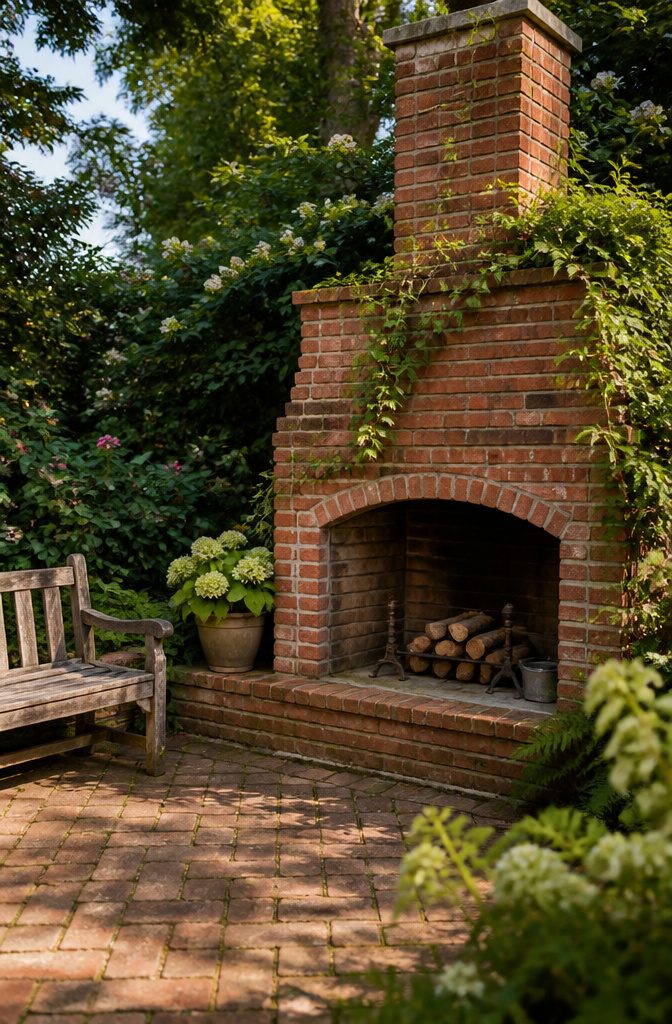
Most bricks end up reddish because the clay used across most states carries iron oxide, and standard firing temperatures leave that iron in a red state rather than pushing it to darker phases.
Higher firing shifts brick toward brown, purple, or the near-black of clinkers, which is why you see those darker tones in Arts and Crafts work from a century ago.
For a patio, that familiar red works when your house already wears brick on its facade, or when you are aiming for cottage warmth against heavy greenery and wood furniture.
I would skip red brick if the surrounding architecture is modern or if the patio sits close to clean-lined siding and metal railings.
The tone clash is real: one designer noted red brick and golden flagstone create tension rather than harmony because the color temperatures sit too far apart.
Regionally, red brick dominates in New England and the Deep South, where whole neighborhoods were built with it. In the rainy Northwest, the same look reads dated enough that builders report very little demand for it anymore.
If you are in one of those brick-heavy regions and your home already uses it, extending the same brick to your outdoor fireplace is the safe, cohesive choice.
Matching decades-old manufactured brick can be the hard part, since some 1970s varieties are no longer produced.

ALL-IN-ONE BRICK FIREPLACE PAINT KIT: A complete DIY fireplace makeover kit with a multi-tone painting system that keeps the natural texture of your brick. Includes 2 base coat sealers, 3 color layers and a glaze layer, plus a paint tray, painters tape, paint brush, 3 rollers with a roller brush, a texturizing sea sponge and easy step-by-step instructions.

ALL-IN-ONE STONE FIREPLACE PAINT KIT: A complete DIY fireplace makeover kit with a multi-tone painting system that keeps the natural texture of your stone. Includes 2 base coat sealers, 3 color layers and a glaze layer, plus a paint tray, painters tape, paint brush, 3 rollers with a roller brush, a texturizing sea sponge and easy step-by-step instructions.
Made in United States
Rustic Farmhouse Brick
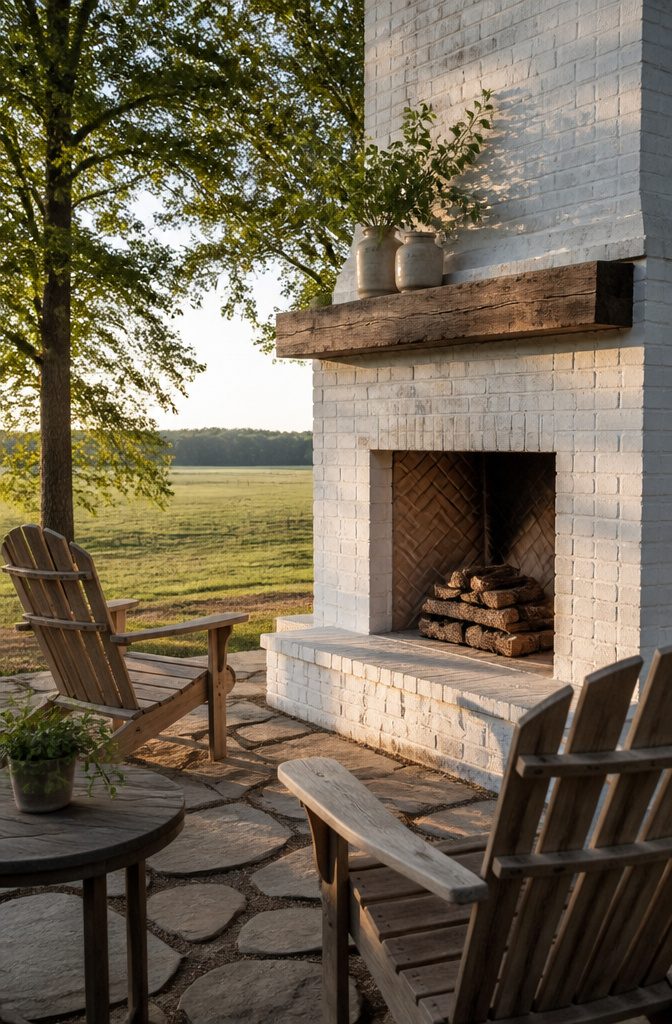
Exposed brick with a wooden mantel or unfinished stone trim reads farmhouse because the materials carry honest wear, not because someone hung a "Live Laugh Love" sign above it.
The line between relaxed and theatrical sits at the mantel itself. A hand-hewn beam with saw marks and a little checking feels collected over time.
A beam sanded to satin and stained espresso looks like a set piece from a catalog shoot, and on an ordinary patio that breaks the illusion fast.
I would keep the surround brick matte and slightly irregular, the kind of used brick that carries depth and color variation rather than uniform beige. That variation lets the white read as painted-over age rather than factory-fresh cladding.
Lanterns or wrought-iron accents can push the rustic side further, but I would stop at one vintage piece, maybe two if the patio is generous. More than that and the space starts performing farmhouse instead of simply being it.
The furniture matters as much as the fireplace. Adirondack chairs or a wooden bench that can take weather without looking precious keeps the tone grounded.
This style works best where the view cooperates, an open field or at least a sight line past the property line, because the whole point is a feeling of retreat rather than enclosure.
On a narrow city lot the same elements can feel like costume; the proportions need breathing room.
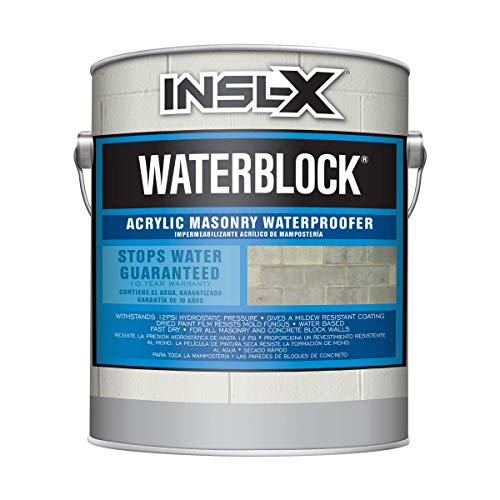
1) Water Based coating for sealing vertical interior and exterior concrete walls. Great for basement walls, foundations and retaining walls.
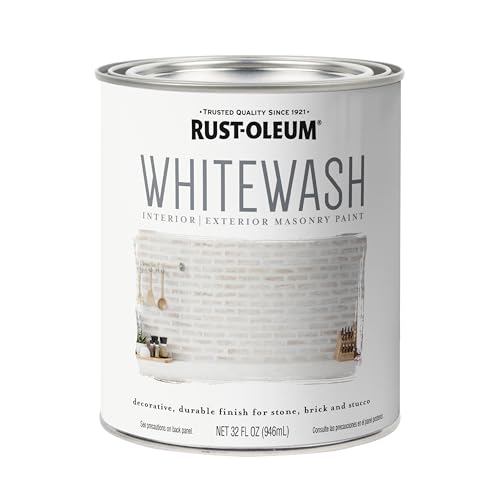
GREAT FOR HIGHLY POROUS SURFACES: Brightens the appearance of stucco, stone, brick and wood while letting natural surface texture shine through

This high-quality, acrylic latex water-base interior/exterior paint offers excellent hiding properties with great adhesion and water repellency on textured interior and exterior surfaces
Modern Minimalist Brick
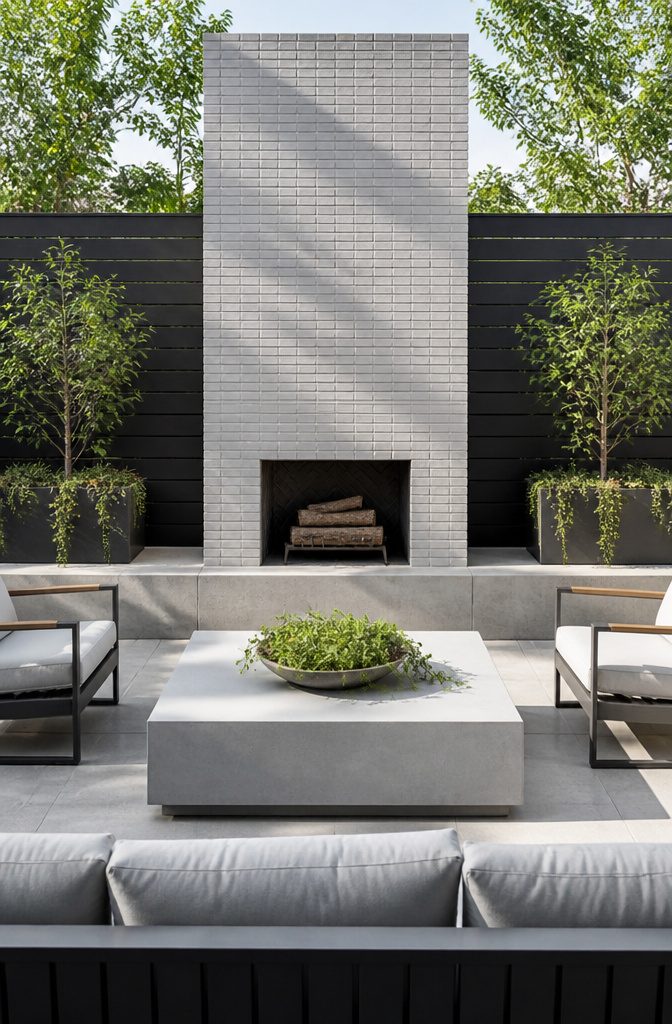
A modern minimalist brick fireplace strips the form down to clean lines and a single tone, usually white or gray.
The brick’s natural texture becomes the only ornament, so the mortar joint is what I would flatten; a tight, flush joint reads as a continuous plane rather than a grid of individual blocks.
Painted finishes like Frosted Sunshine or Misty Harbor from a brick fireplace paint kit disguise the brick’s variation and push the surface toward uniform, which is the point of the style.
The tension sits between brick’s inherent roughness and minimalism’s demand for calm. I would keep the texture, because smoothing or veneering over real brick costs more than this budget allows and loses the material’s honesty.
What I would lose is any corbel, arch, or projecting hearth that breaks the silhouette. The fireplace reads as a simple box or a vertical shaft, nothing more.
For a weekend project on a few hundred dollars, paint is the practical path. Existing brick takes the color directly; no demolition, no masonry skills.
The risk is that white shows soot quickly, so I would size the firebox for gas rather than wood if the budget stretches, or plan to repaint every couple of seasons.
A focal point that holds its own against sleek furniture without competing for attention is exactly what a small urban backyard needs.

Premium Refractory Mortar: Ideal for fireplace repair and chimney repair, this durable fire brick mortar bonds firebrick and masonry, cures hard, and withstands temperatures up to 2,000°F for long-lasting repairs

This high-quality, acrylic latex water-base interior/exterior paint offers excellent hiding properties with great adhesion and water repellency on textured interior and exterior surfaces

This brick paint fits all home decoration styles. It adopts non-toxic low-odor water-based formula. The full set of painting tools is contained in the fireplace makeover kits, requiring complicated pre-work, so DIY newbies can finish wall renovation effortlessly
Corner Brick Fireplace
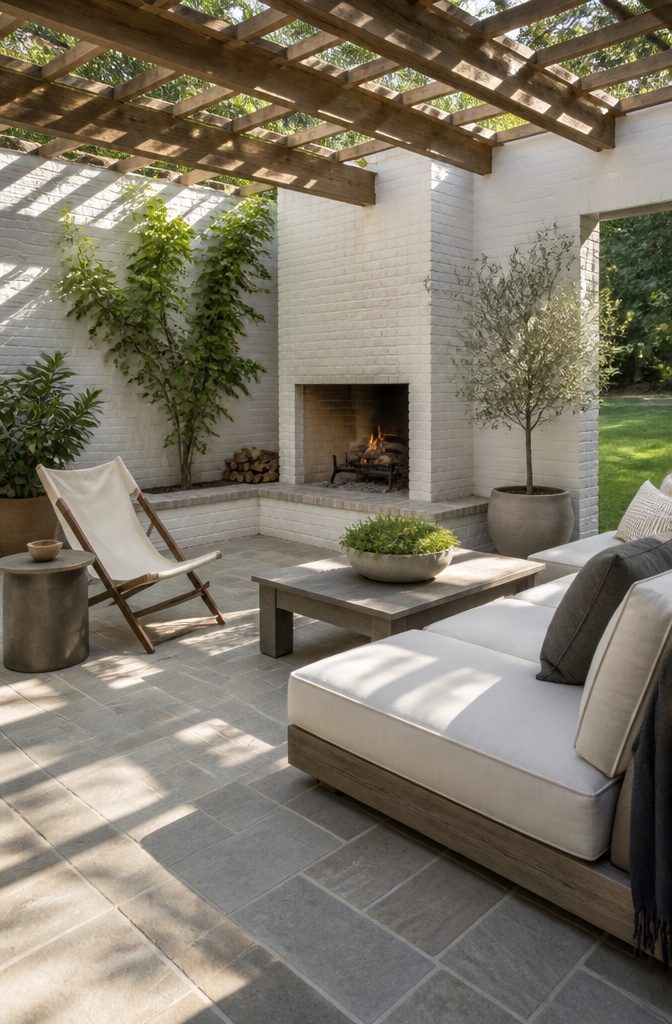
A corner placement forces the fireplace to do more work than a centered one.
The two-sided exposure means you are building against two planes instead of one, so the footing and the firebox need to tie into a corner structure that carries load in two directions.
That changes what you can build against: a corner fireplace needs either a true corner in your patio layout or a purpose-built return wall, and that wall becomes part of the architecture rather than just a backdrop.
The real value is in how the space around it behaves. A corner fireplace leaves the rest of the patio open and continuous, which matters on a small footprint.
You are not splitting the seating into two disconnected groups facing a central object; instead, the fire tucks into the angle and the seating wraps around the open side in a single arc.
Folding chairs and a small table can pull up snugly without anyone sitting in a dead zone where the heat does not reach and the sight line to the flame is broken.
The problem is the viewing angle. From the far corner of a wraparound sofa or a chair pulled too wide, the firebox reads as a narrow slice instead of a full face.
I would keep the seating depth to about 90 degrees of wrap, no more, and I would skip any design that tries to make the fireplace a corner TV mount.
A brick surround can frame a screen above the firebox, but that only works when the fireplace faces the viewer squarely.
In a corner, the off-angle glare and the neck-crank ruin the effect, and the space-saving reason for corner placement is lost if you then have to float furniture to face two directions at once.
Leave the brick in its natural light tone or paint it to match the patio palette, but keep the geometry clean.
A corner fireplace already has enough visual lines running to it; busy brick patterns or strong color shifts just emphasize the awkward junction.
Safe and effective cleaner for your hearth brick and stone

Mediterranean-Inspired Brick
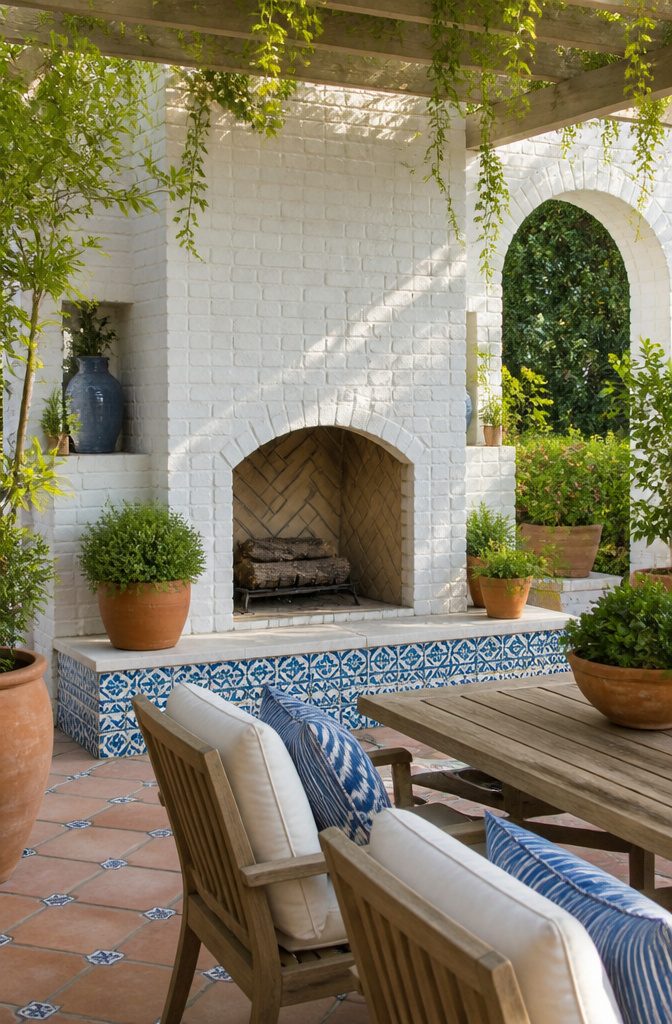
Whitewashed brick carries a chalky, irregular finish that reads softer than a flat coat of paint.
The lime or diluted paint settles into the mortar lines and leaves the brick face partly visible, which gives the wall dimension that reads coastal rather than simply white.
Stucco-adjacent treatments work the same way: a troweled, slightly uneven surface that catches light differently across the day and pairs naturally with terracotta, wrought iron, and the blues and greens of Mediterranean tile accents.
This finish suits patios that get real sun. The brightness holds up without glare, and the texture hides dust and water spotting better than a smooth painted surface would.
I would skip it on a shaded northern exposure where the chalky tone can turn flat and cold; there, smooth painted brick actually carries more life.
For a sunny space, though, the combination of arched fireplace openings, textured white surrounds, and seating with bright cushions builds warmth without heavy color on the structure itself.
The texture is what separates Mediterranean from merely white; painted brick is a color choice, but whitewashed or stucco-finish brick is a light strategy.
Brick Fireplace With Pizza Oven
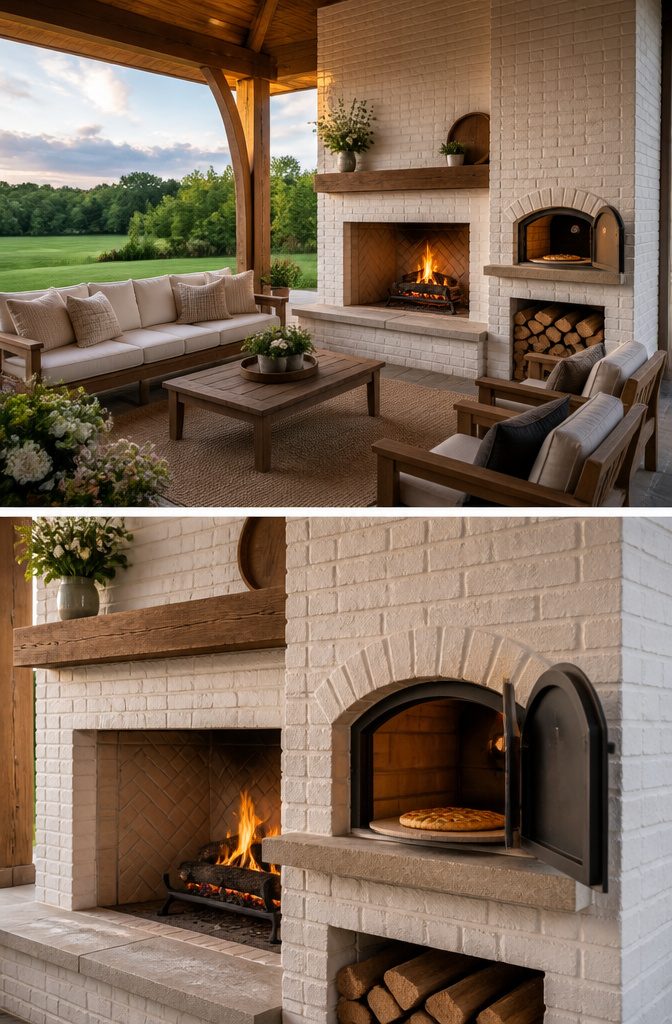
A pizza oven stacked above the firebox is the usual arrangement, and it changes how the whole structure breathes.
The chimney has to pull draft for both openings at once, which means the flue sizing and throat placement matter more than they do for a fireplace alone.
Get it wrong and smoke exits the front of the lower firebox while you are trying to enjoy the evening.
The kits that exist for this solve the internal geometry, and for a weekend builder that is probably the saner path than hand-mixing firebrick and guessing at throat dimensions.
What the kit does not solve is the sheer mass of masonry involved. A white brick outdoor fireplace patio with an oven above it is a two-person pour over multiple weekends, not a single Saturday with a wheelbarrow.
Whether the cooking function earns that labor depends on how often you would fire the oven for something other than pizza. Bread, roasted vegetables, or a whole fish turn the oven into a real cooking tool.
If the plan is three pizzas in July and nothing else, the extra cost and the extra chimney engineering are not worth it. I would skip the oven and put the savings toward a wider hearth and better seating.
The people who love this setup are the ones who light it every weekend through the season and use the residual heat for hours after the flames die down. That is the test.
Fireplace With Built-In Wood Storage
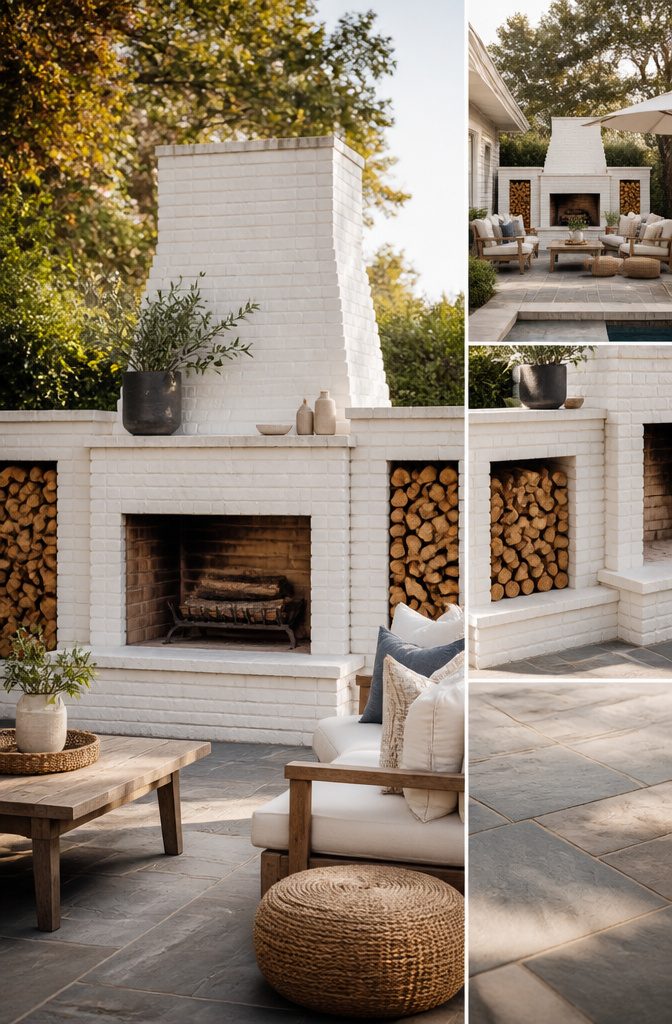
Built-in wood storage flanking a white brick outdoor fireplace keeps logs within arm’s reach and gives the structure a tidier, more intentional silhouette than a freestanding rack off to the side.
The stacked rows frame the firebox symmetrically and carry that rustic warmth through the whole patio wall.
The problem is what happens where firewood meets heated masonry. Store your split wood at least 18 inches from the firebox opening, not flush against it, and never in the alcove directly above where heat rises.
Brick holds temperature long after the flames die, and cured hardwood can dry to the point of becoming tinder.
For airflow, I’d leave the back of each storage bay open to the wall or drill a few low vents so air moves through the stack.
Damp wood molds; stagnant air invites ants and the mice that follow. A slatted base or a few inches of clearance off the patio floor lets water drain after rain instead of soaking into the bottom row.
A simple metal mesh screen across the back opening stops most pests without blocking the breeze you need.
White brick shows soot and water stains faster than red, so I’d keep only a weekend’s worth of wood in the open bays and store the rest seasonally in a covered bin.
The built-ins stay full enough to look complete, and you are not watching white mortar darken where wet bark pressed against it.
Two-Sided Brick Fireplace
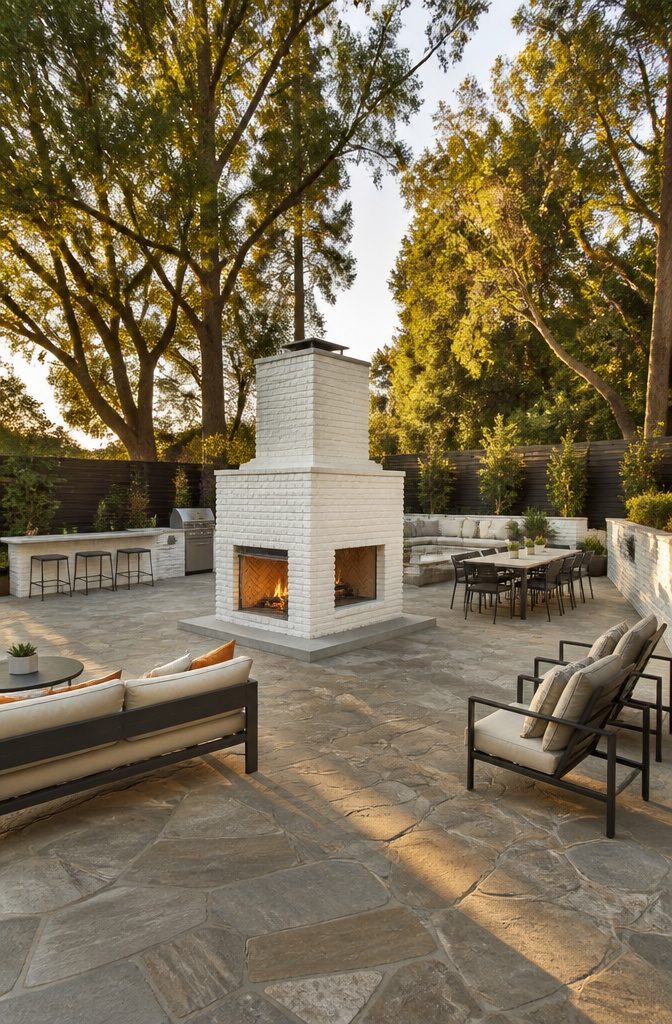
A two-sided white brick outdoor fireplace patio setup lets you split one fire between a dining area and a lounge without crowding either side.
Guests on both faces get the heat and the view, and the symmetry does more for the space than two separate fireplaces ever would.
The compromise is real. Two openings mean the firebox loses heat faster and drafts harder to control, smoke can drift toward the side with less wind, and the foundation has to carry double the masonry load.
I would not build one unless the patio is wide enough that people actually gather in two distinct zones.
If your space is under about 400 square feet, a single-sided fireplace against the far wall gives you the same warmth with half the headache and a shallower footing.
For larger patios, the two-sided unit is worth the extra concrete and the careful damper tuning.

Skip Sanding And Priming: transform your home with this no sand no prime cabinet paint that requires no stripping, sealing, or top coat for a complete finish

ENAMEL FLOOR PAINT: Provide your floors with an extremely durable and long-lasting finish using California Paint ALLFLOR Porch, Patio and Floor Enamel Paint.

Best-in-class fire brick for the absorption and retention of heat
Stacked Brick With Bench Seating
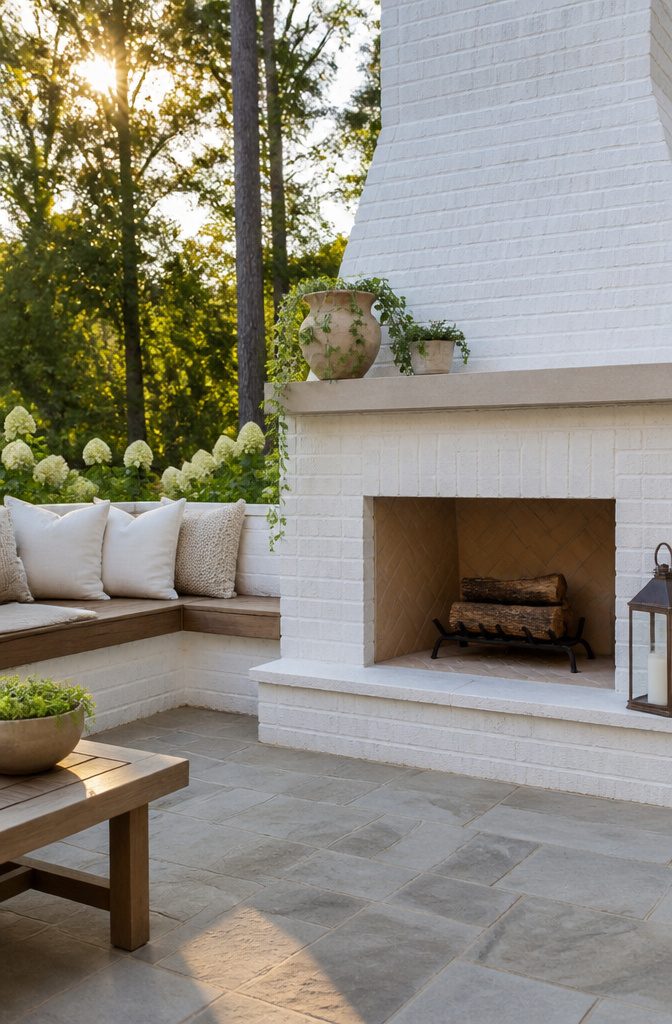
The bench that grows straight out of a white brick outdoor fireplace patio is the detail that makes or breaks the space.
Brick courses extend horizontally from the firebox to form seating walls, usually 18–20 inches high and deep enough for two people to sit without touching knees.
That integration saves the $800–$1,400 you would spend on weatherproof sectionals or teak benches, and it eliminates the annual ritual of dragging cushions to garage storage before the first frost.
What you give up is rearrangement.
The seating faces the fire, period; there is no pivoting the conversation toward sunset views or away from a neighbor’s window. I would live with that trade, but I would not live with bare brick against my back.
A 4-inch cushion in Sunbrella or a similar acrylic turns the wall from hardscape into furniture, and a row of 12-inch lumbar pillows against a simple wood or metal back rail keeps the posture comfortable through a two-hour evening.
Without that back support, guests perch rather than settle, and the wall reads as a ledge you happened to sit on, not seating you designed.

🔥【Universal Refractory Mortar】 Powerful Bond, Defies Extreme Heat: Specifically engineered for temperatures up to 1420°C (2600°F),Masonry mortar for joining and repairing flue tiles in any fireplace (gas/wood) or stove (wood/coal/pellet).
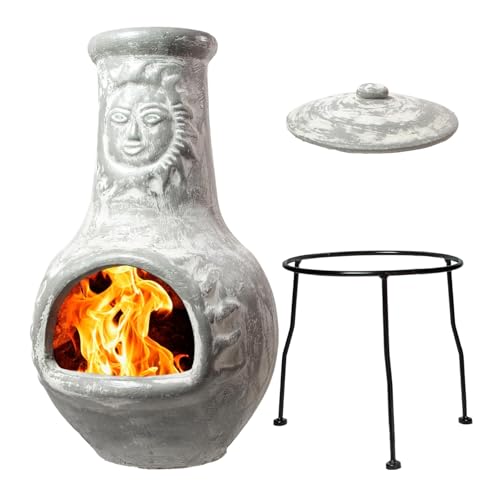
Medium Size: The chiminea comes in a medium 16 x 16 x 32-inch size that can easily fit in your backyard illuminating your outdoor area for evening activities.

JUST ADD WATER: Mix this concentrated formula with water to prepare the amount needed for your project. The water-based pigment penetrates clean, porous concrete instead of sitting like opaque paint, supporting semi-transparent color on an indoor floor or outdoor surface.
Freestanding Brick Fireplace
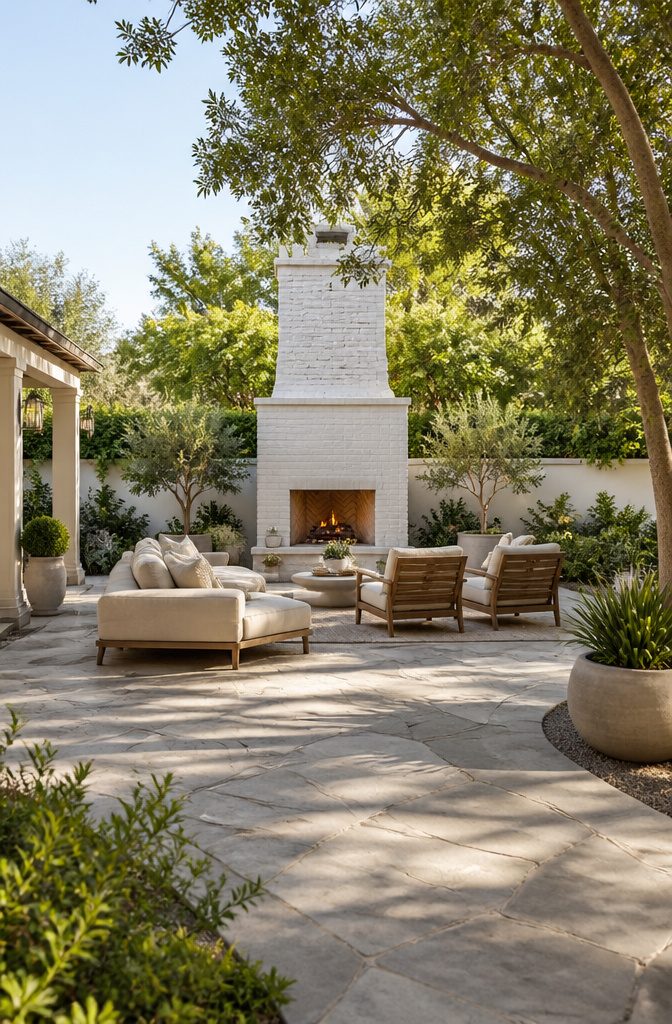
A freestanding white brick outdoor fireplace sits like an island in your patio layout, visible from every angle rather than backed against a wall or fence.
That changes everything about how you build it. Each face needs full structural support and finished masonry, which means roughly double the material and labor of a single-sided build against your house.
The foundation is the part I’d never skimp on. Four-sided exposure means four-sided wind load, and a freestanding chimney catches gusts from directions a wall-anchored unit never faces.
You want a poured concrete footing that extends below your frost line and spreads wider than the chimney base; anything less and you’ll watch mortar joints crack within a season or two.
Wind exposure also dictates your bond pattern.
Running bond with full head joints on every face handles shear stress better than decorative patterns with clipped corners. I’ve seen stacked bond with its clean vertical lines fail early in open yards where a wall-mounted version held fine.
The shape reads as deliberate architecture, not leftover construction.
It defines conversation areas on all four sides, which is wonderful for entertaining but demands more square footage than most patios give comfortably. For a weekend project on a real budget, this is where I’d pause.
The freestanding white brick outdoor fireplace is the statement piece I’d save for when I had the space and the subgrade already handled. Until then, a wall-backed version delivers the same warmth for half the masonry.
Brick Fireplace With Waterfall
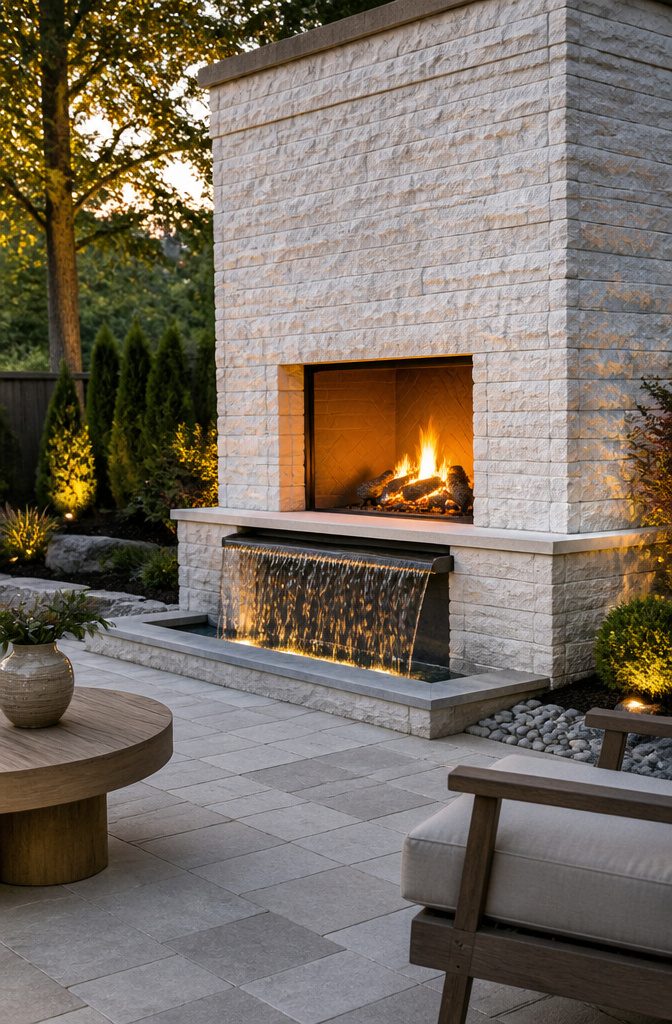
A white brick outdoor fireplace patio with a waterfall works best when the water drops directly behind or beside the firebox, not in front of it.
The sound covers the quiet lulls in conversation, and the reflected light doubles what either feature manages alone.
I would keep the firebox raised at least 18 inches above the basin so wind-driven spray does not hit hot brick, because thermal shock cracks mortar joints faster than you would expect.
The contrast between fire and water is the reason for the pairing, but the maintenance is real.
Hard water leaves a white mineral film on any brick within the splash zone, and that film dulls the white finish within a season.
I would plan for a softener on the supply line or commit to scrubbing with a mild acid wash twice a year.
The pump and basin also mean this is not a project for a single weekend or a tight budget.
If you are already managing a pool or pond, the extra load is familiar. If not, a simpler fountain off to the side gives most of the effect with none of the grief.
Circular Brick Fire Pit Fireplace
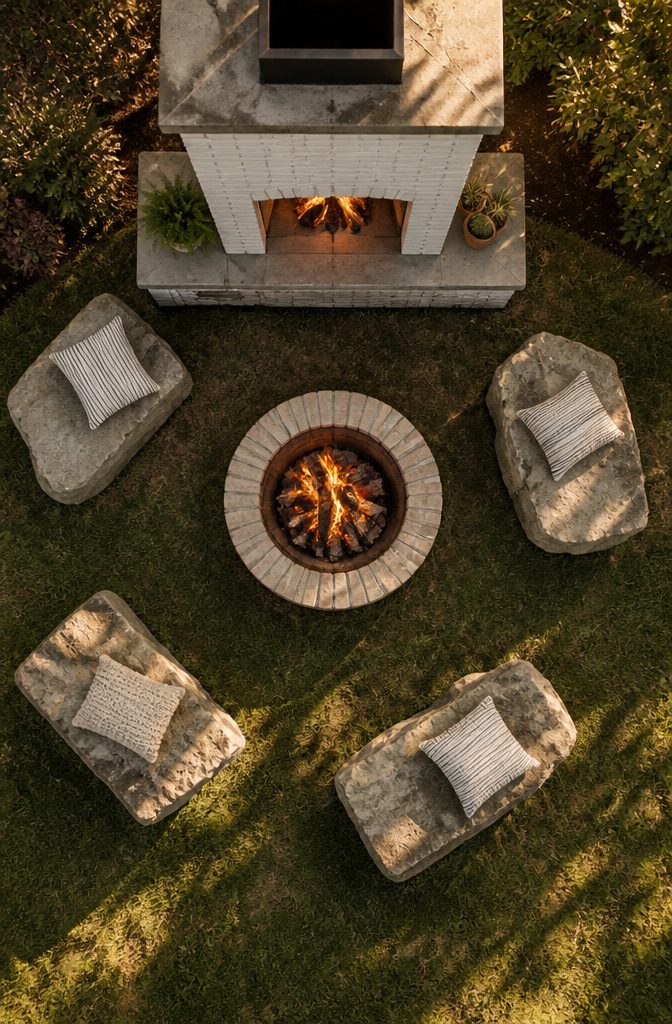
A low circular brick fire pit sits flush to the ground, usually 12 to 18 inches tall, meant for gathering around rather than sitting beside.
Add a partial wall or two, raise the ring to waist height, and the thing starts behaving like a fireplace: it blocks wind, radiates heat in one direction, and frames the flames. That partial wall is the line.
Once you have 3 feet of brick rising on one side with an opening for logs and a ledge wide enough for a coffee cup, you have crossed from fire pit into fireplace territory, even without a chimney overhead.
I would call it a fireplace once the structure dictates where you sit, not just where you stand. A tall ring with gaps for air is still a fire pit.
A half-circle of brick backing a patio bench, sending smoke up and away from the seats? That is a fireplace in function, if not in name, and it belongs in this search.
Brick Fireplace With Pergola
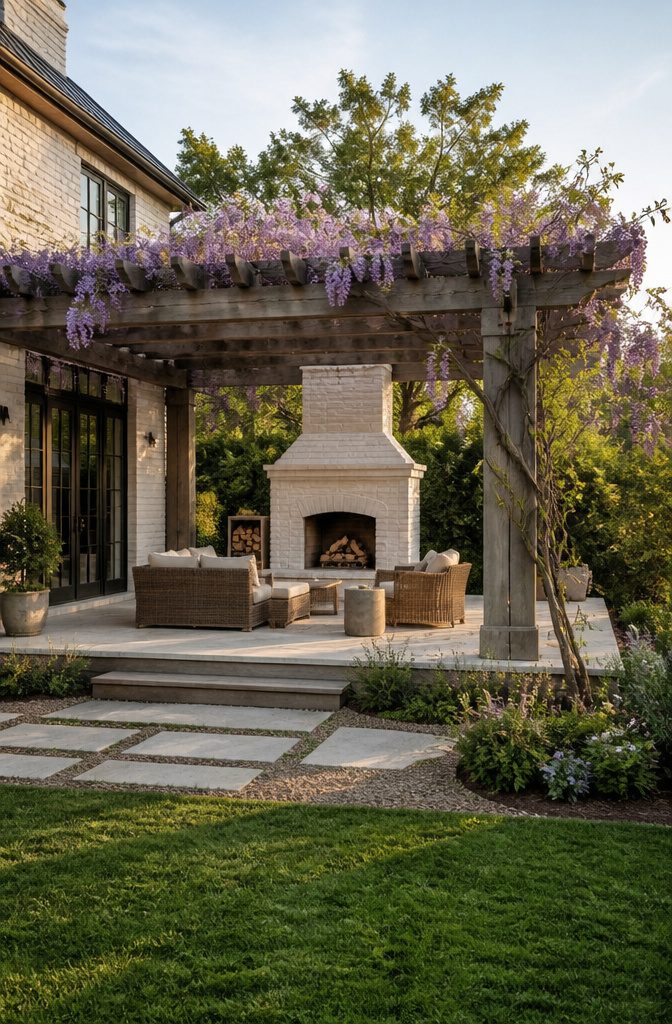
A pergola overhead turns a white brick outdoor fireplace patio into something you actually use, not just something you look at.
The slatted roof gives partial shelter from midday sun and a frame for string lights or trailing vines, but it never walls the space in.
That half-open quality is what keeps the fireplace from feeling like an indoor room dropped outside.
The smoke path matters here more than most people think. A pergola that sits too low or runs too far forward can trap smoke under its beams instead of letting it rise and disperse.
Building codes generally want at least 8 feet of clearance from the firebox to any overhead structure, and some jurisdictions push that to 10 feet depending on the beam depth.
Check your local rules before the posts go in, because a permit inspector will measure from the top of the firebox opening, not the patio floor.
Whether the pergola attaches to the fireplace or stands independent is a choice with real consequences.
Tying them together gives a unified look and saves a pair of posts, but it puts lateral stress on the chimney every time wind hits the slats. I would keep them separate unless the fireplace was engineered for that load.
Two freestanding structures with a 6-inch gap between them handle weather and settling without fighting each other, and the visual break is hardly noticeable once vines or lights soften the line.
Patio Fireplace With Seating Wall
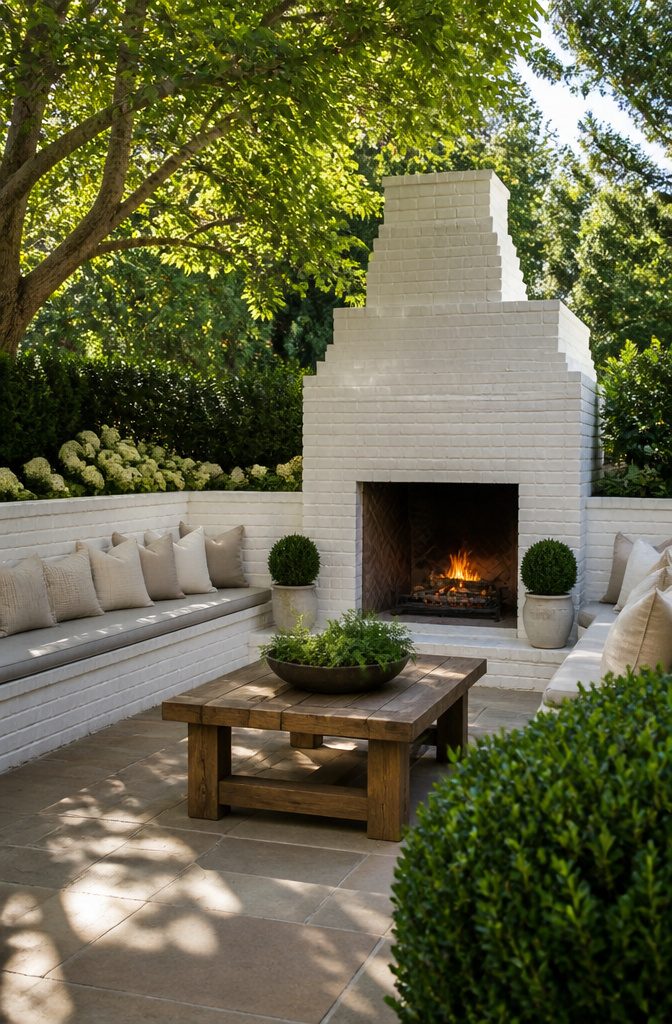
A seating wall set apart from the fireplace gives you two structures to work with instead of one monolithic block.
The wall can wrap in a U-shape to define the conversation area, run parallel as a facing bench, or sit at a right angle to block wind.
Each layout changes how people gather. The U-shape keeps everyone facing the fire and cuts the space off from the rest of the patio; parallel seating opens the group outward and works better if you entertain in larger numbers.
Matching the brick to the fireplace unifies the patio and lets the firebox read as the focal point. Painting both the same warm white, or using the same whitewash technique, keeps the eye moving across clean lines.
Contrast only works if the materials actually differ, not just in shade. A limestone or poured concrete wall against white brick gives you texture variation; two slightly different whites just look like a mistake.
Cost stays lower when you keep the wall low, around 18 inches, and skip backrests. That height still works for standard cushions and gives you a place to set a drink plate.
If you want a backrest, budget for capstone and proper drainage behind the wall, because trapped water will push through mortar joints within two winters.
Tall Fireplace With Chimney
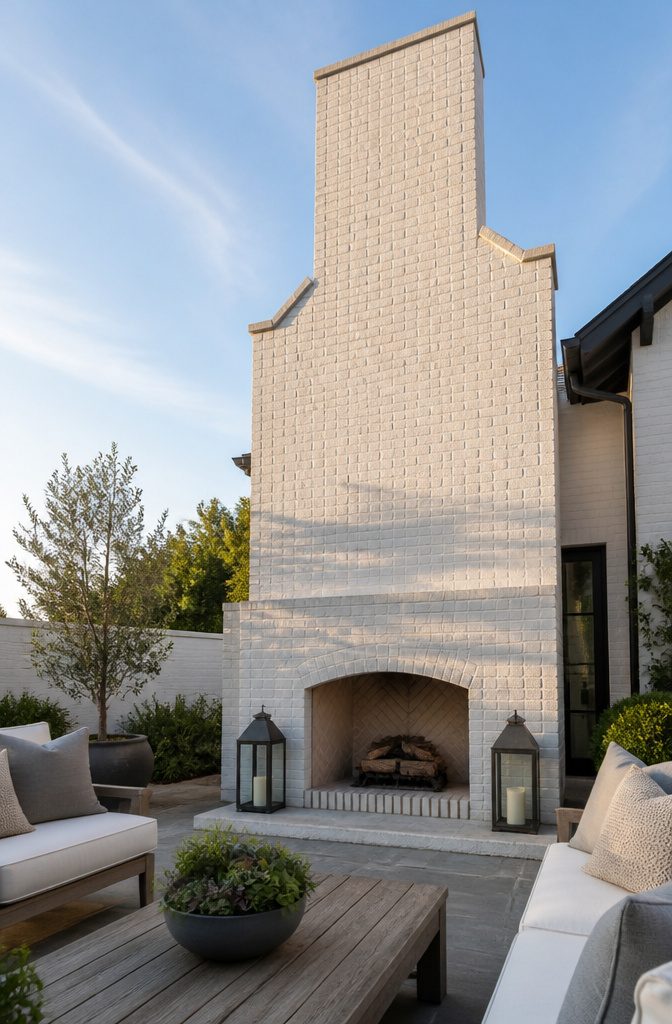
A tall white brick fireplace with a chimney extension draws the eye upward and gives a patio real presence against a two-story house or an open yard.
The vertical line matters for sight lines from inside the house too; a low fireplace disappears behind furniture, while a tall stack registers through windows and sliding doors as a deliberate architectural feature.
The chimney does practical work. It channels smoke vertically, which keeps the seating area cleaner and reduces the chance of a gust blowing embers toward guests.
In most setups, a chimney extension is the functional piece that makes the fire usable rather than ornamental. That said, once the flue is tall enough to clear the draft requirement for the firebox size, any additional height is gesture.
The masonry kit from one manufacturer becomes a custom piece when a mason adds that extension and ties the hearth into an existing rock wall, which is the move I would make if the patio already has stone elsewhere.
Proportion is the judgment call here. Against a single-story ranch, a chimney that reads as bold on a two-story wall can look like a smokestack.
I would keep the total height within one story of the roofline it faces, unless the fireplace sits at the center of a lawn where nothing competes with it.
In that open placement, the height becomes the organizing point for the whole yard, and a chimney extension is worth the extra courses of brick.
Brick Fireplace With Grill Insert
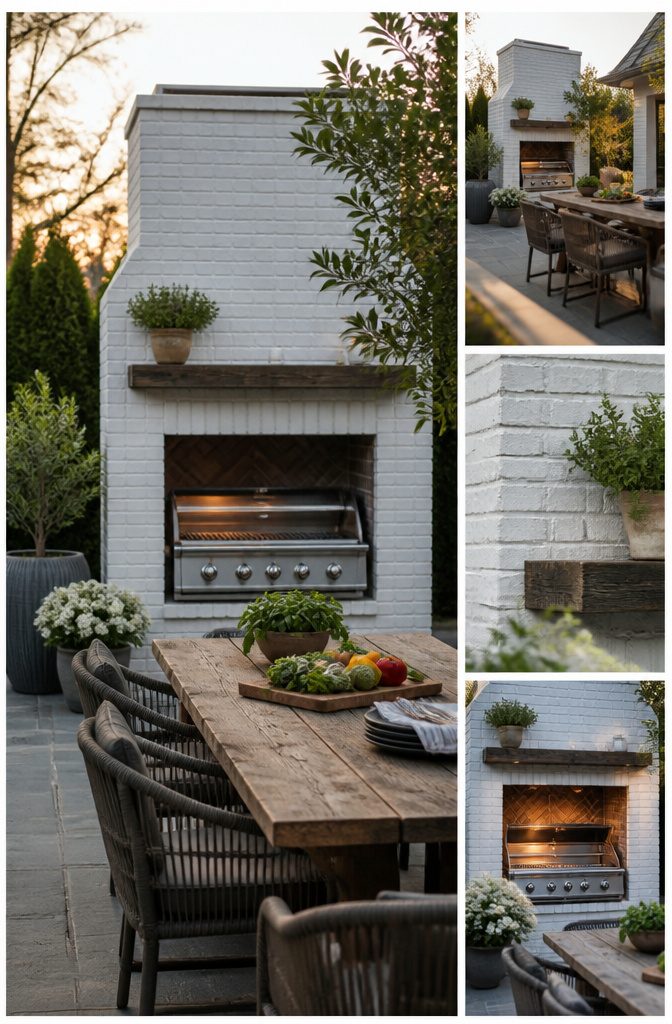
A grill insert turns the firebox itself into the cooking surface.
You get a grate that sits across the opening, often with adjustable heights or a rotisserie rod mounted above, and the whole setup borrows the fireplace’s existing masonry for heat retention.
That masonry is the difference from a standalone grill: the brick absorbs and radiates steady heat rather than blasting direct flame, so you are working slower and more even, more offset-smoker logic than searing station.
This is not a pizza oven. A pizza oven needs a domed ceiling and a stone floor to bounce concentrated heat upward, usually built as its own chamber beside or above the firebox.
The grill insert stays open to the air; you lose the dome physics and you do not get the 700°F floor that crisps a crust in ninety seconds.
What you gain is flexibility. You are roasting a chicken on the spit while the fire warms guests seated nearby, and the same structure handles both jobs without duplicating footprint or chimney costs.
Whether it replaces a standalone grill depends on how you cook. If your weekend involves quick weeknight burgers, the fireplace’s slower startup and cleanup will frustrate you.
If you entertain on Saturdays with whole cuts and vegetables in foil, the insert earns its keep and the standalone becomes redundant. I would keep the portable propane unit for Tuesday nights and let the brick fireplace carry the gatherings.
Brick Fireplace With Mosaic Tile
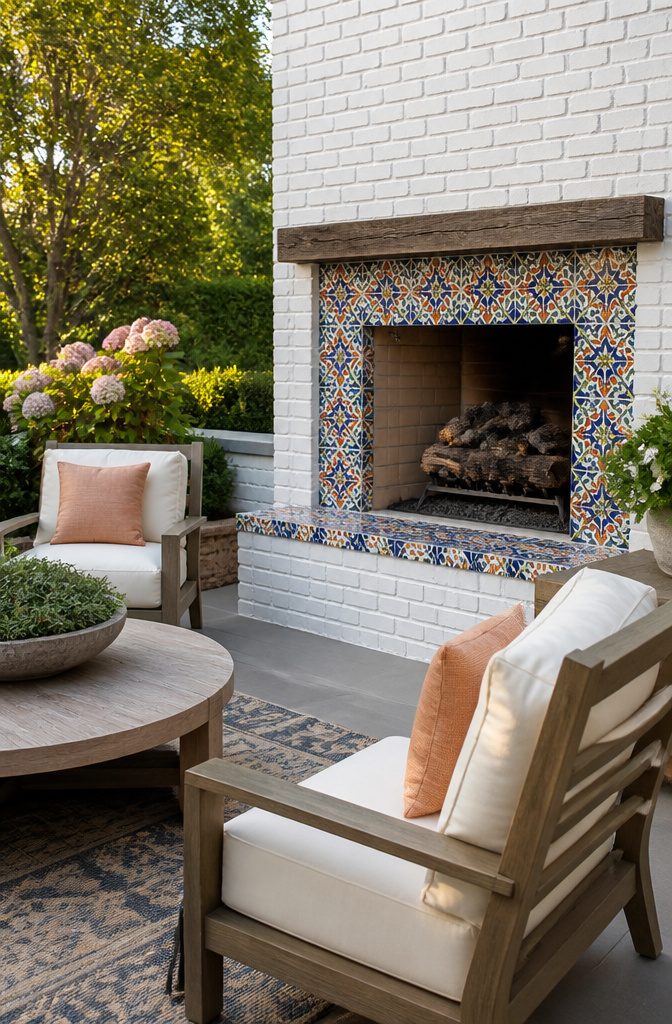
Mosaic tile on a brick fireplace does what paint cannot: it adds color without flattening the texture underneath.
I would keep the tile to the firebox surround, the hearth ledge, or a narrow vertical strip flanking the opening, places where the eye expects a shift in material anyway.
A full face of tile defeats the point of choosing brick, but a six-inch border of vivid blue or green mosaic turns the firebox into a framed picture and lets the white brick read as architecture around it.
Grout outdoors is the detail that decides whether the accent lasts. Unsanded grout cracks under freeze-thaw cycling; sanded or epoxy-based grout with a polymer additive handles the movement better.
I would pick a grout color one shade darker than the tile, not the brick, so the pattern reads as deliberate inlay rather than a repair job.
The cost is maintenance: the more intricate the mosaic, the more surface area to clean of ash and pollen, and the more edges where water can sit if the crown or cap lets it through.
For a weekend project on a real budget, a simple running bond of subway tile on the hearth gives ninety percent of the effect with none of the fuss.
Double-Layered Brick Fireplace
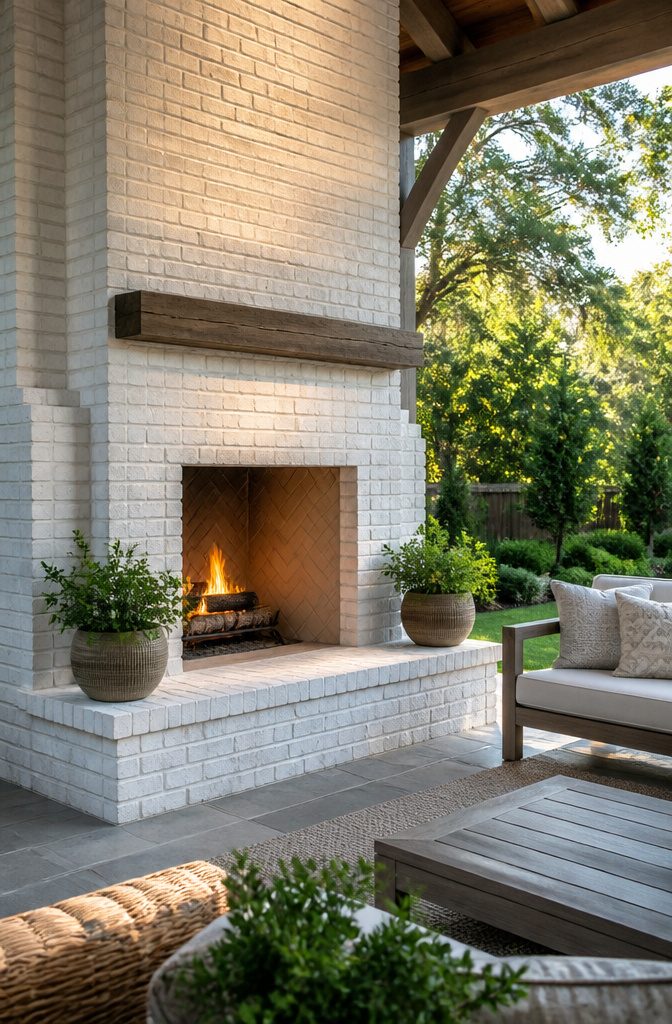
A double-layered brick fireplace is built from two separate wythes: an inner structural wall that carries the load and handles the firebox heat, and an outer veneer layer that faces the patio.
The gap between them, usually an air space with ties, is what lets each skin do its job without cracking the other. For a white brick outdoor fireplace patio, that separation matters more than it would indoors.
The inner wythe expands and contracts with temperature swings you simply do not get in a living room, and the outer layer takes the weathering while staying visually crisp.
The offset between the two layers creates shadow lines at every opening and corner that read as thickness, not sticker-thin cladding.
You see it at the firebox mouth and at the chimney cap, where the step-back catches late-day light. That depth is the difference between a fireplace that sits on your patio and one that anchors it.
Cost splits cleanly here.
Whole-brick veneer demands serious structural support, specialized anchorage, and the skilled labor to lay it. Thin brick veneer, sometimes as slim as one inch, installs more like tile: lighter shipping, less substantial anchorage, and less need for a seasoned mason.
I would skip whole brick for anything freestanding or built on an existing slab unless the budget has room for engineering that does not show.
Half brick or thin veneer gets you the same white face with money left for the hearthstone and seating you will actually use.
Brick Fireplace With Metal Accents
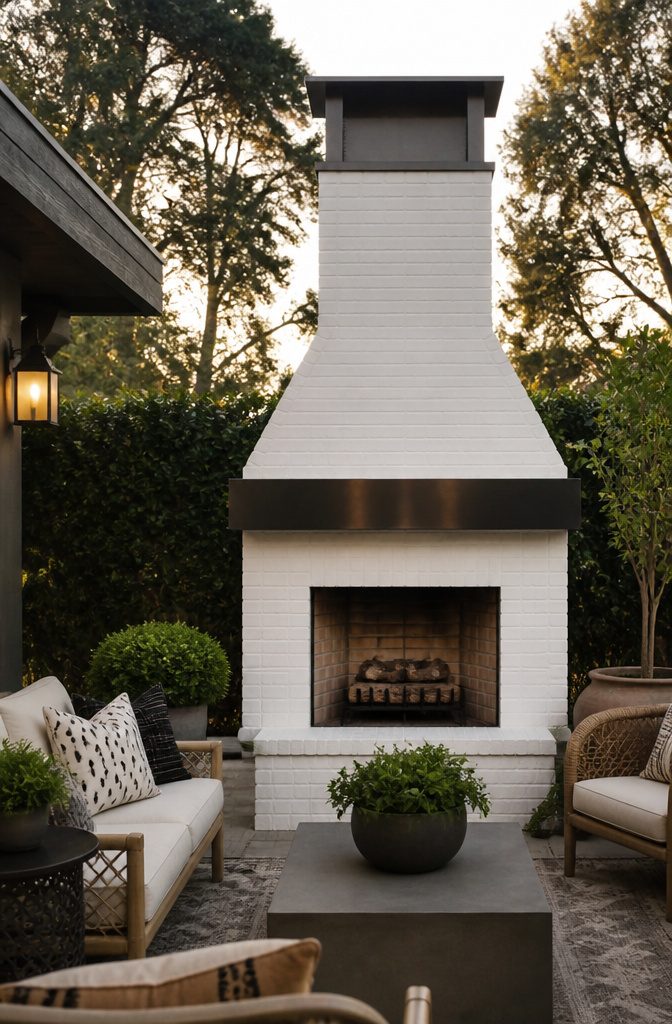
Steel or iron framing around the firebox, a blackened lintel band, or a chimney cap in brushed metal gives a white brick outdoor fireplace patio the sharp edge that keeps it from reading as cottage-core soft.
I like the pairing because masonry absorbs light while metal throws it back, so the fireplace reads as architecture rather than backdrop. Brass or copper warms the mix; steel and black iron push it toward industrial or contemporary territory.
The risk sits in the physics. Metal expands faster than brick when heated, and if the two materials are locked tight with rigid fasteners, something cracks over a season or two.
Leave a gap or use a slip joint where the metal band meets the masonry, and always separate dissimilar metals from the brick with a break that stops galvanic corrosion.
Stainless grates and doors hold up best; iron looks right but needs seasoning and eventual replacement if you are cooking over the firebox regularly.
Frequently Asked Questions
Is a brick fireplace right for me?
A brick fireplace fits you if you want authentic style and long-term durability, though you will need to accept higher installation labor and a palette limited to what clay and firing temperatures produce.
Painted brick kits like Brick-Anew’s expand your color options to white or gray if the natural range does not suit your patio. The trade-off is visible weathering and touch-up every two to three years outdoors.
What color brick works best for an outdoor fireplace patio?
White and gray reflect daylight and keep seating areas feeling open, which makes them the most flexible choice for coastal, modern, or small patios.
Red brick works when your house already wears it or when you want cottage warmth against heavy greenery, but it clashes with clean-lined modern architecture.
Darker clinkers or brown bricks suit Arts and Crafts settings or wet climates where standard red reads dated.
How do I paint an existing outdoor brick fireplace?
Use a kit formulated for brick texture and absorption, such as Brick-Anew’s Misty Harbor (gray) or Frosted Sunshine (white), rather than standard exterior latex that chips at firebox edges.
The paint disguises stained mortar and brick variation for a cleaner, intentional look. Plan to touch up every two to three years, especially on the firebox surround where heat and moisture stress the finish.
What is the difference between a fire pit and an outdoor fireplace?
A fire pit sits 12 to 18 inches tall and lets people gather around it from all sides.
Once you add a partial wall that rises to waist height, blocks wind, radiates heat in one direction, and frames the flames with a ledge wide enough for a drink, you have crossed into fireplace territory even without a chimney.
The structure dictating where you sit, not just where you stand, is the dividing line.
How much does it cost to build a freestanding brick outdoor fireplace?
A freestanding white brick outdoor fireplace needs roughly double the material and labor of a single-sided wall-backed build because every face requires finished masonry and full structural support.
The foundation must extend below your frost line and spread wider than the chimney base to handle four-sided wind load. For a real budget or single weekend, a wall-backed version delivers the same warmth for half the masonry.
How far should a pergola be from an outdoor fireplace?
Building codes generally require at least 8 feet of clearance from the firebox top to any overhead structure, and some jurisdictions push that to 10 feet depending on beam depth.
A pergola sitting too low or running too far forward traps smoke under its beams instead of letting it rise.
Keep the pergola and fireplace as separate structures rather than tying them together, so wind hitting the slats does not put lateral stress on your chimney.
Can I add a pizza oven to my outdoor brick fireplace?
Yes, but the chimney must pull draft for both the firebox and oven openings simultaneously, so flue sizing and throat placement matter more than with a fireplace alone.
Kits solve the internal geometry, yet the total masonry mass makes this a multi-weekend, two-person pour rather than a quick project.
Only add the oven if you will fire it regularly for bread, roasted vegetables, or fish beyond occasional summer pizzas.
How do I store firewood safely next to an outdoor fireplace?
Keep split wood at least 18 inches from the firebox opening, never flush against it, and avoid alcoves directly above where heat rises. Brick holds temperature long after flames die, and cured hardwood can dry to tinder.
Leave the back of each storage bay open or add low vents for airflow, raise the base a few inches off the patio floor for drainage, and screen the back opening against pests.
What seating works with a brick fireplace patio?
Built-in bench seating extending from the fireplace wall at 18 to 20 inches high saves $800 to $1,400 on weatherproof furniture and eliminates seasonal cushion storage, though you lose the ability to rearrange.
Add a 4-inch Sunbrella cushion and 12-inch lumbar pillows against a simple back rail so guests settle rather than perch. For separate seating walls, keep them low and match the brick or paint both structures the same tone for unity.
Should I build a two-sided outdoor fireplace?
Only if your patio exceeds about 400 square feet and you genuinely gather in two distinct zones, such as a dining area and a lounge.
Two openings lose heat faster, draft harder to control, and demand double the foundation load and careful damper tuning. On smaller patios, a single-sided fireplace against the far wall gives the same warmth with half the headache.
How do I maintain a white brick outdoor fireplace?
White brick shows soot, water stains, and mineral film faster than red, so plan for more frequent cleaning and touch-ups.
Painted finishes need attention every two to three years, especially around the firebox where heat cycles and moisture stress the surface.
If you add a waterfall, soft water or twice-yearly acid scrubbing prevents hard-water dulling within a season. Store only a weekend’s worth of wood in open bays to keep mortar from darkening where wet bark presses against it.